Dual-Process Production Line for Spiral and Longitudinal Welded Pipes: Key Technologies and Applications
Abstract: To overcome the limitations of conventional production lines, in which spiral and longitudinal welded pipe manufacturing are configured separately, including inefficient process switching and limited production capacity, this study examines the world's first 18.3-m-long dual-process production line capable of manufacturing both spiral and longitudinal welded pipes. The study evaluates the feasibility and performance of a flexible, shared-line production model that integrates the two manufacturing processes, focusing on:
- Forming accuracy of longitudinal welded pipes
- Welding process stability
- Production efficiency
- Physical and mechanical properties of the weld seams
The results demonstrate that the production line supports flexible, in-line switching between the two manufacturing processes while combining their respective advantages to ensure consistent product quality and reliable performance. Furthermore, product changeovers can be completed without stopping the production line, resulting in a 20%–30% increase in production efficiency. This production model provides a replicable technical solution for the manufacture of high-end energy-sector pipes, with its stability and reliability validated through industrial application.
Traditionally, spiral submerged arc welded (SSAW) and longitudinal submerged arc welded (LSAW) pipes are manufactured on separate, dedicated production lines. This arrangement requires substantial capital investment and large plant areas, while also presenting several operational challenges:
- Long changeover times between manufacturing processes
- Limited coordination and operational flexibility between production lines
- Insufficient responsiveness to urgent orders and small-batch production requirements
As a result, conventional production facilities face difficulties in meeting the growing demand for a diverse range of products, particularly ultra-long, thick-walled, and high-grade steel pipes manufactured in small batches with multiple specifications. To address these challenges, CNPC Baoshishun (Qinhuangdao) Steel Pipe Co., Ltd. (hereinafter referred to as "the Company") independently developed an 18.3-m-long dual-process welded pipe production line (hereinafter referred to as "the dual-process line") within its existing spiral welded pipe workshop. The line integrates spiral and longitudinal welding processes into a single production system, allowing both processes to operate on the same line and enabling rapid changeover between them. Through comparative testing, this study evaluates the production efficiency, operational stability, and manufacturing reliability of the dual-process line. The findings provide a technical basis for assessing the feasibility of this production model and its potential for wider industrial application.
The spiral–longitudinal dual-process system enables a single production line to manufacture both spiral submerged arc welded (SSAW) and longitudinal submerged arc welded (LSAW) pipes, with the flexibility to switch rapidly between the two processes or operate them simultaneously.
Based on order specifications, material requirements, and delivery schedules, the system selects the most suitable production route to meet specific manufacturing requirements. By sharing a common set of core production equipment between the two processes, the system offers several key advantages:
- Reduced capital investment through equipment sharing
- Increased production capacity and equipment utilization
- Greater operational flexibility in responding to changing market demand
- Improved production continuity and supply reliability
The dual-process production line adopts a "two-front, one-rear" layout, as illustrated in Figure 1. The front section consists of two independently arranged forming areas: one for spiral forming and the other for longitudinal forming. Each area is housed in a separate bay, allowing the two forming processes to operate simultaneously without interfering with each other.
The rear section accommodates the downstream operations shared by both production routes, including:
- Internal and external finish welding
- Non-destructive testing (NDT)
- Hydrostatic testing
- Pipe-end processing
- Final finishing
These downstream operations are integrated into a centralized production system and shared by both manufacturing routes. Switching between the two routes is controlled through a single-command interface, enabling coordinated operation and flexible production scheduling.
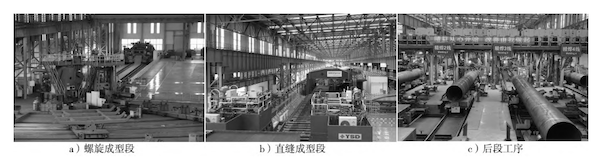
a) Spiral-forming section b) Longitudinal-forming section c) Shared downstream processes
Figure 1. "Two-Front, One-Rear" Layout
The spiral-forming section primarily consists of the following equipment and systems:
- Loading mechanism
- Uncoiler
- Coil head-and-tail butt-welding unit
- Edge-milling machine
- Strip delivery system
- Spiral-forming unit
- High-speed pre-welding unit
- Flying cutoff device
- Pipe transfer carriage
- Automated forming and welding control system
The production line maintains continuous operation through coil head-and-tail butt welding and high-speed pre-welding, achieving a maximum stable welding speed of 7 m/min. This represents more than twice the production efficiency of conventional single-step methods and demonstrates significant improvements in production continuity and automation.
The longitudinal-forming section primarily consists of the following equipment and systems:
- JCO forming press
- Plate inspection unit
- Edge-milling machine
- Edge-prebending machine
- Seam-closing and pre-welding machine
- Electrical control system
The section is equipped with an 18.3-m modular JCO forming press, which addresses key technical challenges associated with the forming of ultra-long, thick-walled, large-diameter pipes. This equipment overcomes limitations in forming accuracy and enables the domestic production of ultra-long longitudinally welded pipes on an industrial scale, filling a gap in China's large-scale manufacturing capabilities in this field.
The dual-process production line incorporates a shared final welding stage, where internal and external welding are integrated into a single station. This arrangement enables sequential welding of longitudinally welded pipes with diameters ranging from 355 to 1,626 mm. By eliminating the need to transfer and reposition pipes between separate internal and external welding stations, the integrated arrangement simplifies the production flow and shortens production cycle times. It also enables fully automated welding operations throughout the entire welding stage.
In addition to final welding, both production routes share the following downstream processes:
- Non-destructive testing (NDT)
- Hydrostatic testing
- Pipe finishing
- Final product inspection
Sharing these facilities improves equipment utilization, reduces redundant equipment and operations, and increases overall production efficiency by 20%–30%.
The dual-process production line supports the simultaneous and independent manufacture of spiral-welded and longitudinally welded pipes. Large-diameter spiral-welded pipes are produced continuously, while smaller-diameter longitudinally welded pipes are formed and welded in parallel. After welding, the longitudinally welded pipes undergo NDT sampling before being temporarily stored in a designated buffer area within the workshop. Once a sufficient number of pipes has accumulated, they are transferred to the shared downstream facilities for final NDT, finishing, and warehousing. This arrangement enables both production routes to operate independently while making efficient use of the available production capacity.
Through strategic maintenance scheduling, downtime for the longitudinally welded pipe line and the dual-process (spiral/longitudinal) production line can be staggered. Combined with coordinated material handling and transfer, this arrangement allows maintenance activities to be carried out on one line while the other continues operating. As a result, overall production and product supply can be maintained without interruption, overcoming the conventional limitation of having to shut down the entire production system during maintenance.
For small-batch orders or urgent requirements, such as pipes needed for emergency repairs, the dual-process production line can flexibly adjust its production schedule to accommodate these orders during available production windows. This approach enables urgent orders to be fulfilled and delivered on time without disrupting the planned production schedule for regular orders.
The spiral–longitudinal dual-process production line was completed in July 2023. Initial trial production was successfully conducted using steel pipes with specifications of Φ406 × 12.5 mm and Φ1,422 × 21.4 mm. Subsequently, batch trial production was carried out on 18-m-long, Φ1,219 × 22 mm longitudinally welded pipes made of Grade 80M steel. These pipes were selected from the specifications required for a major project undertaken by the National Pipe Network. The trial production results are presented below.
Following the successful completion of the automatic welding procedure qualification, two steel pipe samples were selected from each of the two heats (heat Nos. 2382004403 and 2383004790; sample Nos. 252169, 252173, 252175, and 252178) for initial inspection. All four pipes underwent non-destructive testing (NDT), pipe-end finishing, and visual inspection. Samples were then taken for further testing. The results are presented below.
(1) Chemical composition analysis results for all four samples met the applicable standard requirements.
(2) All samples passed the guided bend tests (bend angle: 180°; mandrel diameter: 195 mm).
(3) The transverse tensile test results for the pipe bodies and the tensile test results for the welded joints all met the specified requirements.
(4) The Charpy V-notch impact test results at −10 °C are presented in Table 1, with the average values given in parentheses. According to the applicable standards, the individual impact energy must be at least 60 J, and the average impact energy must be at least 80 J. The shear area values are provided for reference only and are not considered in the compliance assessment.
(5) The drop-weight tear test (DWTT) results showed shear areas ranging from 92% to 100% across the four sample sets, with an average exceeding 96%. All results were satisfactory.
Table 1. Charpy V-Notch Impact Test Results at −10 °C
Pipe No. (Initial Inspection) | Sampling Location | Charpy Impact Energy (J) | Shear Area (%) |
250824 | Weld | 177, 168, 154 (166) | 85, 80, 81 (83) |
Heat-affected zone (HAZ) | 240, 221, 234 (232) | 92, 90, 90 (91) | |
250828 | Weld | 188, 155, 170 (171) | 86, 80, 90 (85) |
Heat-affected zone (HAZ) | 238, 297, 264 (266) | 88, 92, 90 (90) | |
250832 | Weld | 190, 161, 178 (176) | 80, 76, 72 (76) |
Heat-affected zone (HAZ) | 200, 218, 220 (212) | 80, 80, 89 (83) | |
250833 | Weld | 154, 168, 160 (160) | 77, 78, 70 (75) |
Heat-affected zone (HAZ) | 255, 195, 278 (242) | 92, 88, 93 (91) |
(6) Weld macro-examination and hardness testing: The penetration depths of the internal and external welds ranged from 1.9 to 3.0 mm, with center deviations ranging from 0.2 to 1.8 mm. The maximum measured weld hardness was 220 HV10. All test results met the specified requirements.
(7) Appearance and dimensional inspection: For the first batch of steel pipes, the weld reinforcement measured 1.2–2.0 mm for the internal welds and 1.0–1.6 mm for the external welds. The weld misalignment (hi-lo) did not exceed 0.5 mm. The straightness deviation was no greater than 3.2 mm within 1.5 m of either pipe end and no greater than 3.8 mm/m along the remaining pipe length.
(8) Non-destructive testing (NDT): In accordance with GB/T 9711—2023, Steel Pipe for Pipeline Transportation Systems in the Petroleum and Natural Gas Industries, and the technical specification DEC-NGP-S-PL-003-2020-1, General Technical Specification for Steel Pipes for Gas Pipeline Projects, the weld seams of the initial production pipes underwent full-length digital radiographic testing (DR) before hydrostatic testing. No unacceptable defects were detected. Following hydrostatic testing, ultrasonic testing (UT) was performed on the weld seams and pipe bodies, revealing no cracks or other unacceptable defects. In addition, ultrasonic testing of the pipe-end bevel faces detected no unacceptable laminations.
(9) Hydrostatic testing: Two steel pipes were hydrostatically tested at 18.7 MPa, while the other two were tested at 19.6 MPa. After maintaining the test pressure for 17 s, the external surfaces of all four pipes were inspected. No leakage was observed.
The above test results demonstrate that the initial batch of X80-grade, Φ1,219 × 22 mm spiral submerged arc welded (SSAW) steel pipes met the requirements of both GB/T 9711—2023 (PSL2) and DEC-NGP-S-PL-003-2020-1.
(1) Chemical composition: Product analysis of the four steel pipe samples confirmed that their chemical compositions met the applicable standard requirements.
(2) Tensile testing: The tensile test results for the base metal and weld seams are presented in Tables 2 and 3, respectively. All weld-seam tensile specimens fractured in the base metal.
(3) Charpy impact testing: Transverse Charpy impact specimens were taken from the base metal at a circumferential position 90° from the weld seam, as well as from the weld metal and heat-affected zone (HAZ) of the welded joint. Each test set consisted of three specimens.
For the base metal specimens, the notch was oriented perpendicular to the rolling surface of the steel coil, with the specimen centerline aligned with the mid-thickness of the pipe wall. For the weld metal specimens, the notch axis was positioned along the centerline of the external weld bead.
Charpy V-notch impact tests were conducted at six temperatures: 20 °C, 0 °C, −10 °C, −20 °C, −40 °C, and −60 °C. Standard specimens measuring 10 mm × 10 mm × 55 mm were used. The test results met the PSL2 requirements of GB/T 9711—2023 and the requirements of DEC-NGP-S-PL-003-2020-1.
Table 2. Tensile Test Results for the Base Metal
Heat No. | Pipe No. | Sampling Direction / Specimen Type | Yield Strength | Tensile Strength | Elongation | Yield-to-Tensile Strength Ratio |
2382004403 | 252169
| Transverse bar specimen | 588 | 700 | 23.2 | 0.84 |
Longitudinal plate specimen | 622 | 717 | 23.5 | 0.87 | ||
252173
| Transverse bar specimen | 611 | 699 | 23.6 | 0.87 | |
Longitudinal plate specimen | 602 | 723 | 23.2 | 0.83 | ||
2383004790
| 252175
| Transverse bar specimen | 598 | 696 | 23.1 | 0.86 |
Longitudinal plate specimen | 630 | 711 | 23.8 | 0.89 | ||
252178
| Transverse bar specimen | 602 | 720 | 23.2 | 0.84 | |
Longitudinal plate specimen | 596 | 688 | 26.6 | 0.87 | ||
Standard requirements (transverse) | 555–690 | 625–765 | ≥21 | ≤0.93 | ||
Table 3. Tensile Test Results for the Weld Seams
Heat No. | Pipe No. | Tensile Strength |
2382004403 | 252169
| 715 |
720 | ||
711 | ||
252173
| 749 | |
735 | ||
2383004790 | 252175
| 749 |
722 | ||
716 | ||
252178
| 696 | |
723 | ||
712 | ||
689 | ||
Standard requirement | ≥625 | |
(4) Drop-weight tear testing (DWTT): All test results were satisfactory. The temperature at which the shear area reached 85% was below −10 °C, while the temperature corresponding to a 10% shear area was −40 °C.
(5) Metallographic examination: Metallographic specimens were taken from the weld seam and the position 180° opposite the weld seam. The examination covered the weld metal, heat-affected zone (HAZ), and pipe body. Ferrite grain size and banded microstructure were evaluated using the method specified for determining ferrite grain size in acicular-ferrite-type linepipe steels. In addition, the macrostructure and geometric parameters of the weld seams were examined and measured.
The microstructures of both the internal and external weld metals consisted predominantly of acicular ferrite, with minor amounts of granular bainite, polygonal ferrite, and lath bainite. The HAZ consisted mainly of massive ferrite and granular bainite, with a small amount of martensite-austenite (M/A) constituents.
The maximum hardness measured across the weld cross-section was 252 HV10, below the standard limit of 280 HV10. All metallographic examination and hardness test results met the PSL2 requirements of GB/T 9711—2023 and the requirements of DEC-NGP-S-PL-003-2020-1.
(6) Geometric dimensions and surface quality: Inspection of the surface quality and geometric dimensions of the steel pipes yielded the following results: weld reinforcement was no greater than 2.0 mm, weld misalignment was no greater than 0.5 mm, and straightness deviation was no greater than 3.8 mm. All measured values met the specified requirements.
(7) Resistance to hydrogen-induced cracking (HIC): The HIC test results showed that the crack length ratio (CLR), crack sensitivity ratio (CSR), and crack thickness ratio (CTR) were all 0%. No hydrogen-induced blistering was observed in any of the specimens.
Table 4. Metallographic Examination Results
Item | Parameter | Result |
Pipe body | Non-metallic inclusions | A0.5, B1.0, C0.5, D0.5e |
Pipe body | Microstructure | Acicular ferrite (AF) + granular bainite + banded pearlite (Grade 1) |
Pipe body | Grain size | Surface: Grade 12; center: Grade 11.5 |
Welded joint | Weld metal microstructure | Intragranular acicular ferrite (IAF) + acicular ferrite (AF) + martensite-austenite (M/A) constituents + pearlite |
Welded joint | Heat-affected zone (HAZ) microstructure | Granular bainite + acicular ferrite (AF) + pearlite |
Welded joint | Weld toe condition | Normal |
The results of the geometric dimensional and surface quality inspections are presented in Table 5. All 86 steel pipes met the specified acceptance criteria and complied with the PSL2 requirements of GB/T 9711—2023 and DEC-NGP-S-PL-003-2020-1.
Table 5. Inspection Results for Steel Pipe Dimensions and Surface Quality
Item | Parameter | Measured Values | Internal Control Standards |
Circumference | Pipe end A (mm) | 3,829.0–3,832.0 | 3,827.1–3,832.1 |
| Pipe body B (mm) | 3,828.0–3,832.0 | 3,825.8–3,834.3 |
Difference in pipe diameter between ends (mm) |
| 0–1.0 | ≤2.0 |
Weld misalignment (mm) |
| 0.3–0.5 | ≤1.6 |
Out-of-roundness (mm) | Pipe end (A) | ≤4.1 | — |
| Pipe body (B) | ≤6.0, ≤9.7 | — |
| Additional measured values | ≤4.4, ≤4.9 | — |
Residual magnetism (mT) |
| 0.9–1.8 | ≤1.6 |
Cut deviation (mm) |
| 1.0–1.3 | — |
Straightness deviation (mm) |
| 4–6 | ≤28 (over the pipe length) |
Wall thickness (mm) |
| 22.08–22.15 | 21.4–23.3 |
Pipe length (m) |
| 18.1–18.3 | — |
Appearance quality |
| Qualified | — |
The results of the full-scale hydrostatic burst test showed that the measured burst pressure exceeded the calculated value. The rupture initiated in the pipe body, and the resulting crack propagated across the weld seam before arresting 100 mm beyond it.
After completing the production run of X80M-grade steel pipes (Φ1,219 × 22.0 mm), the forming team reconfigured the spiral-welded pipe unit to manufacture X80M-grade steel pipes with a specification of Φ1,219 × 18.4 mm. As final welding of the longitudinally welded pipes was being completed, the pre-welded spiral-welded pipes were already being transferred to the final welding station. Meanwhile, finishing and inspection of the longitudinally welded pipes continued. Within six hours, the longitudinally welded pipes completed the entire production cycle and were ready for warehousing, while the spiral-welded pipes continued through the finishing line toward final warehousing.
Industrial application has demonstrated that the dual-process production line enables parallel operation, flexible changeover, and coordinated production, delivering significant efficiency gains. Overall production efficiency increased by 22.4%, while the time required to switch between pipe diameters was reduced from several hours to just a few minutes.
(1) Improved Capacity Utilization and Enhanced Supply Reliability: The coordinated operation of the two manufacturing processes overcomes capacity bottlenecks and enables continuous production across a wide range of pipe specifications and product types. This has significantly strengthened the production line's ability to meet the delivery requirements of large-scale projects and respond to urgent supply needs.
Since its commissioning in 2023, the dual-process (spiral/longitudinal) production line has supplied more than 760 km of steel pipe for major national pipeline projects and other key applications, including the Sichuan-II Pipeline, the Changshi Pipeline, the Jilin Oilfield CCUS Project, the hydrogen pipeline from Damao Banner to Baotou in Inner Mongolia, and the UAE P5 Export Project. Its performance has received broad recognition within the industry.
(2) Simultaneous Improvements in Product Quality and Production Efficiency, with Significant Cost Savings: Through process optimization and the integration of intelligent technologies, the production line has significantly improved pipe dimensional accuracy, weld quality, and overall production stability. Production efficiency has increased by 20%–30%, while unit manufacturing costs have steadily decreased, further strengthening the company's market competitiveness. In recognition of its achievements, the company was named a "Lean Benchmark Enterprise in Equipment Manufacturing" by PetroChina for 2025.
(3) An Innovative Production Model Driving High-Quality Industry Development: The flexible dual-process production system represents an original and pioneering achievement in welded pipe manufacturing. It provides the industry with a new approach to flexible production and offers valuable experience for the development of advanced manufacturing technologies. The system also contributes to China's transition from a major pipe producer to a global leader in the pipe manufacturing industry.
The 18.3-m-long spiral/longitudinal dual-process welded pipe production line features an innovative "two-front, one-rear" shared-line layout and a flexible, coordinated manufacturing model. By integrating spiral and longitudinal welded pipe production on a single line and enabling flexible process switching and parallel operation, this approach addresses several longstanding industry challenges, including fragmented equipment investment, inefficient production changeovers, insufficient supply capacity, and limited capabilities for manufacturing ultra-long pipes. Results from small-batch trial production, large-scale engineering validation at the 100,000-ton level, and full-scale commercial production demonstrate that the line supports rapid process changeover, parallel production, and flexible coordination between spiral and longitudinal pipe manufacturing. Changeover time has been reduced from hours to minutes, increasing overall production efficiency by 20%–30%, with a measured improvement of 22.4%. In addition, the production line has overcome key technical challenges in forming, welding stability, and dimensional accuracy control for 18.3-m-long longitudinally welded pipes, filling a gap in China's industrial-scale manufacturing capabilities for ultra-long, high-grade longitudinally welded steel pipes.