Floating Rubber Hoses: Design, Advantages & Operational Use
In modern marine engineering, port dredging, and offshore resource development, floating rubber hoses, as a key transfer device, play an irreplaceable role. This flexible pipeline system, specially designed for surface operations, through a unique multi-layer composite structural design, successfully addresses many limitations of traditional rigid pipelines in dynamic marine environments. This article will provide a comprehensive analysis of floating rubber hoses, from structural composition, core features, main classifications to application scenarios, highlighting their technical characteristics and practical value.
The excellence of floating rubber hoses originates from their scientific layered design concept. Typical products are usually composed of five key parts, with materials of each layer selected according to functional requirements.
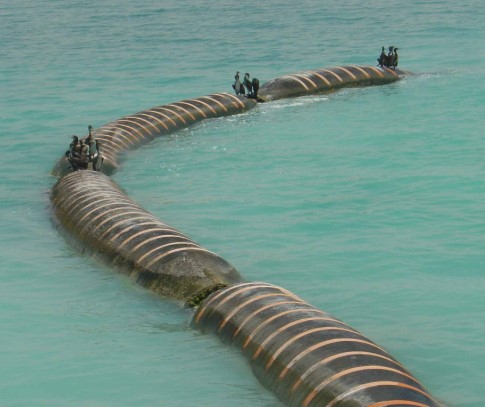
The inner layer is the first line of defense of the hose, directly contacting transported media such as crude oil, fuel oil, slurry, or seawater. This layer is made of specially formulated synthetic rubber, with core performance indicators including wear resistance and corrosion resistance. When conveying sand-laden slurry or chemical media, the inner layer effectively prevents mechanical wear from solid particles and chemical corrosion, avoiding internal damage to the hose. Depending on the transported medium, manufacturers choose different rubber formulations, such as oil-resistant rubber for petroleum transport and acid/alkali-resistant rubber for chemical media.
Located outside the inner rubber layer, this layer serves as the "skeleton" of the hose. It uses multi-layer steel wire braiding or high-strength fiber winding processes, mainly to withstand expansion caused by internal transport pressure and external tensile forces. Under high-pressure transport conditions, the reinforcement layer ensures the hose does not excessively expand or deform radially, maintaining a stable flow cross-section. Steel wire reinforcement structures are suitable for high-pressure conditions, while fiber reinforcement is more suitable for weight-sensitive applications.
The buoyancy layer is the core component for achieving flotation, usually made of high-density closed-cell foam material, arranged in the middle or outer layer of the hose. This foam material has extremely low water absorption and continuous buoyancy-providing capability. Notably, high-quality buoyancy layers use a closed-cell structure, so even if the outer protective layer is locally damaged, the foam core does not absorb water, maintaining the hose's buoyancy. Some designs use external buoyancy rings or floats as supplements, usually made from lightweight, durable materials such as polyethylene or polyurethane.
Facing the marine atmosphere, the outer layer must handle the triple challenges of seawater corrosion, UV exposure, and mechanical wear. This layer uses special rubber compounds resistant to salt spray and aging, capable of long-term exposure to high-humidity marine environments without cracking or degradation. During hose recovery and deployment, the outer layer must also withstand dragging and friction, so wear resistance is equally important.
Serving as connection components, both ends are equipped with standard flanges or quick connectors for easy connection to pumps, valves, or other pipeline equipment. The design must consider sealing reliability and installation convenience, commonly using steel flanges or rubber-composite flanges.
Floating rubber hoses are widely used in marine engineering due to their significant performance advantages over rigid pipelines such as steel or HDPE pipes.
This is the most intuitive feature. Traditional underwater pipelines require additional floats or anchoring systems to maintain a suspended state, whereas floating hoses achieve self-buoyancy through an internal foam layer. This feature greatly simplifies deployment and recovery operations, reducing labor and machinery input, and directly improving construction efficiency. In emergencies, operators can quickly deploy or retract the hose system.
The flexible structure design allows the hose to adapt to continuous wave motion and tidal changes in marine environments. Rigid pipelines under such dynamic loads are prone to stress concentration, resulting in loose joints or pipe body fractures. The flexible characteristic of floating hoses allows them to move with waves, releasing stress through bending rather than twisting, avoiding structural damage caused by bending. This “flex over rigid” design significantly enhances system reliability under harsh sea conditions.
The outer salt-resistant rubber resists seawater and atmospheric corrosion, while the inner materials are designed for chemical corrosion protection. Whether exposed to external seawater conditions or internal corrosive chemical transport, the hose maintains stable performance. This dual-protection design greatly extends maintenance intervals and reduces life-cycle costs.
From low-viscosity crude oil, fuel oil, and seawater to high-solid-content dredging slurries and sand mixtures, floating hoses achieve stable transport. The customizable inner lining allows adaptation to different chemical properties and wear levels, while the reinforcement layer ensures the hose does not sink when transporting heavy media.
Achieved through composite reinforcement structures, multi-layer steel or fiber reinforcement allows the hose to withstand high internal working pressures, meeting high-pressure conditions such as petroleum transport or long-distance slurry transport. Meanwhile, the reinforcement layer provides sufficient axial strength, preventing elongation under tensile loads.
Based on safety levels and application requirements, floating rubber hoses can be divided into single-carcass and double- carcass basic types.
- Single-Carcass Hose Structure: Consists of a single transported medium layer and reinforcement structure, featuring simple design, lower manufacturing cost, and wide applicability. This structure is suitable for conventional dredging or water transport projects with low-risk media and controllable environmental hazards. Advantages include lightweight, good flexibility, and low cost, but it lacks secondary protection in the event of inner layer damage.
- Double-Carcass Hose Structure: Adopts independent inner and outer layers, forming a “hose-in-hose” protective system. This structure significantly enhances safety and environmental protection: if the inner layer is damaged by wear or corrosion, the outer layer still contains the medium, preventing leakage into the marine environment. Some high-end systems include leak alarms that monitor pressure changes between layers or install sensors to detect inner layer damage and alert operators for preventive maintenance. Double-carcass structures are especially suitable for transporting crude oil, chemicals, or other environmentally sensitive or hazardous media, as well as operations in ecologically fragile areas.
Additionally, based on the hose's position in the system, marine hoses can be further classified into vessel-side hoses, main floating hoses, etc., to adapt to specific applications such as Single Point Mooring (SPM) systems.
The technical characteristics of floating rubber hoses make them the preferred equipment in multiple marine engineering areas.
- Dredging and Land Reclamation: Traditional applications involve connecting dredgers to discharge areas, transporting sediment-laden slurry and sand. Dredging hoses usually have thick wear-resistant inner layers to resist abrasion from sand, rocks, and coral, and flange connections are reinforced to withstand high mechanical loads. When used with industrial hose floats, system stability in waves is further enhanced.
- Offshore Oil & Gas Development: Hoses transport crude oil, refined fuels, and drilling fluids between offshore platforms, FPSOs, and transport vessels. These applications typically use designs compliant with the OCIMF (Oil Companies International Marine Forum) standards, requiring high pressure, oil corrosion resistance, and adaptation to SPM system dynamics. Double-layer structures are almost standard in this field to prevent marine pollution.
- Underwater Mining and Tailings Transport: In deep-sea mining, floating hoses transport mineral slurry from barges to processing ships or discharge ponds. Tailings hoses are specially designed to handle the chemical corrosion and physical abrasion of tailings, ensuring safety and durability when transporting high-solid-content, corrosive slurry.
- Offshore Fuel Supply and Water Transport: Hoses provide stable ship-to-ship or ship-to-shore connections, requiring flexibility and weather resistance. They are also widely used in environmental projects for water transfer or emergency oil recovery.
- Subsea Pipeline Construction Support: Although auxiliary, floating hoses are used to support and guide equipment during underwater cable and pipeline installation, providing temporary surface operation platforms.
In practice, floating rubber hoses are often used with industrial hose floats to form a more stable and safer transport system.
Industrial hose floats are buoyancy-assist devices designed specifically for hoses, usually made of high-density polyethylene (HDPE) or polyurethane foam-filled structures. They are fixed at specific positions on the hose using clamps or straps, providing additional buoyancy support. The advantages of combined use include:
- Enhanced Uniform Buoyancy Distribution: For heavy media or long pipelines, the hose's own buoyancy may be insufficient. Properly arranged floats compensate for local buoyancy deficits, preventing sagging or sinking.
- Improved System Stability: Under wave action, hoses may drift or rotate laterally. Floats increase the waterline area, providing a restoring moment, reducing abnormal movements, and maintaining pipeline stability.
- Adaptation to Different Water Depths: In shallow waters, hoses must maintain a draft to avoid collision with vessels; in deep water, sufficient buoyancy prevents sinking. Adjusting the number and spacing of floats allows flexible adaptation to water depth and operating conditions.
- Protection from Mechanical Damage: Floats form a physical barrier, reducing direct contact with other objects and lowering wear risk.
Correct construction and regular maintenance are essential to ensure long-term reliable operation of floating rubber hose systems.
- Installation: Lay hoses sequentially from one end to the other to avoid tangling or twisting. When connecting flanges, ensure sealing surfaces are clean, and bolts are symmetrically tightened to prevent leakage. For long pipelines, anchor points or float supports should be reasonably arranged to control the curvature radius of suspended sections.
- Recovery: Avoid excessive bending and dragging wear. Typically, reels or dedicated lifting equipment are used for recovery. Dragging over long distances on the ground is prohibited. After recovery, hoses should be cleaned, especially the inner cavity after transporting slurry or oil, ensuring residues are fully removed.
- Inspection: Regular checks include appearance inspection (outer layer cracks, wear, UV aging), connection inspection (flange loosening, seal aging), and buoyancy tests (check whether the buoyancy layer absorbs water and fails). For double-layer hoses, the functionality of leak alarm systems should also be monitored.
- Storage Management: Hoses should be stored in a cool, dry place, avoiding direct sunlight and ozone erosion. Long-term storage requires keeping hoses relaxed to avoid permanent deformation from folding.
Floating rubber hoses, through the integrated application of material science, structural engineering, and fluid mechanics, successfully solve key technical challenges of fluid transport in marine environments. Their self-buoyancy, dynamic adaptability, corrosion resistance, and medium compatibility demonstrate irreplaceable value in dredging, energy, and mining fields. As offshore development extends to deep and extreme environments, floating hose technology continues to evolve toward higher pressure ratings, stronger wear resistance, and smarter monitoring. For engineering decision-makers, a deep understanding of hose structural characteristics and application points, along with reasonable selection of product specifications and supporting equipment, is a fundamental basis for ensuring safe, efficient, and economical operation of marine engineering projects.
