Guide to Industrial Piping Fittings Selection
In the design and maintenance of industrial piping systems, the choice of pipe fittings directly determines the system's operational efficiency, safety, and maintenance costs. Selecting the wrong fitting can lead to leaks, pressure loss, system failures, or even safety incidents. This article systematically introduces how to select appropriate piping fittings, covering functional analysis, technical parameters, connection methods, and material selection, to help engineers and procurement personnel make correct decisions.
Before selecting a fitting, it is essential to clearly understand what functions the system needs to achieve. Different fittings perform different tasks, mainly categorized into three types: controlling the direction of the medium, creating system maintenance access points, and sealing the piping system.
- Changing fluid direction: Elbows should be selected. 45-degree and 90-degree elbows can precisely control the flow turning angle. Long-radius elbows have a gentler curvature than short-radius elbows, generating less flow resistance, suitable for systems sensitive to pressure drop. Street elbows, with one end male-threaded and the other female-threaded, reduce the number of connections in tight spaces.
- Sealing pipe ends: Caps or plugs should be used. Caps cover the pipe end externally, while plugs seal from the inside. Both prevent fluid leakage or external contaminants from entering. These components can be used as temporary closures during construction or as permanent sealing solutions.
- Connecting different materials or diameters: Adapters are the correct choice. Adapters can resolve compatibility issues between NPT and BSP threads and can also connect threaded ends to flanged ends. When planning branch pipelines, tees can create T-shaped layouts. Standard tees have three openings of the same size, while reducing tees have different diameters for the main and branch lines. Four-way fittings can split flow in four directions, but because they bear stress from all four directions, they are prone to premature failure under high pressure. Engineers usually recommend using multiple tees instead of a four-way fitting.
Maintenance requirements must also be considered. Permanently welded connections have high strength but are difficult to disassemble. Unions, composed of three parts, allow installation and removal without rotating the pipe, suitable for pumps, valves, and other equipment requiring frequent maintenance.
After determining the functional type, three key technical parameters must be verified: fitting size, pressure rating, and thread standard.
Fitting size labeling should match the pipe's inner diameter (ID), in inches or millimeters. Note that pipe size refers to the nominal diameter, not the actual measured value. For example, a nominal 2-inch pipe usually has an actual outer diameter of 60.3 mm. The internal diameter at the fitting connection should be slightly larger than the pipe's ID to maintain stable flow and prevent local constriction, which can increase flow velocity and cause pressure loss. Oversized fittings waste costs, while undersized fittings limit flow, increase system pressure, and reduce overall efficiency.
Fittings must withstand the system's maximum working pressure with a safety margin. For example, Class 150 malleable iron fittings can withstand 65.5 PSI at 300°F (150°C). However, as temperature rises, material strength decreases, and pressure-bearing capacity is reduced. When selecting fittings, both the internal medium temperature and external environment temperature must be considered, consulting manufacturer-provided temperature-pressure correction tables.
Thread compatibility directly affects connection sealing. The two main thread standards in global industrial applications are North America's National Pipe Taper (NPT) and the British Standard Pipe (BSP) used in the UK and Commonwealth countries.
There are three differences between these two threads:
- Thread angle: NPT is 60°, BSP is 55°
- Thread profile: NPT has straight, sharp peaks and valleys; BSP is rounded
- Thread pitch: Some sizes may match per inch, but most specifications differ
NPT and BSP threads look similar but are incompatible. An NPT male thread may screw into a BSP female thread but cannot form an effective seal, creating a spiral leakage path. In high-pressure systems, this misconnection may cause sudden disconnection, posing a hazard. Thread type can be identified with a pitch gauge; NPT threads feel sharper. When connecting different threads, special adapters must be used, and forced assembly is prohibited.
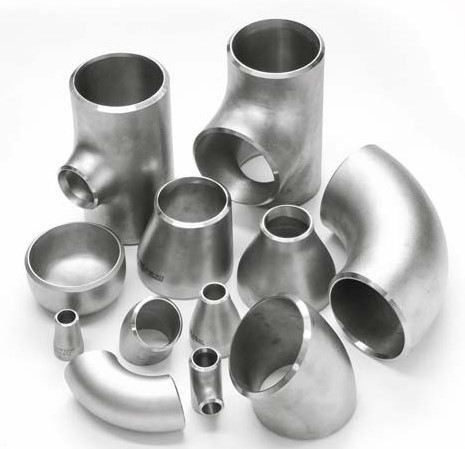
Industrial piping systems use a wide variety of fittings, each with specific functions.
Elbows are used to change the direction of the pipeline, commonly 45°, 90°, or 180°, with long-radius elbows reducing flow resistance. Materials include carbon steel, low-alloy steel, stainless steel, and copper, suitable for high-pressure steam, chemical liquids, water supply, and petroleum pipelines. Elbows can be socket weld, butt weld, or threaded, selected according to pipe pressure rating and medium characteristics.
Tees are used for branch, merge, or branch connections. Equal tees are suitable for systems with equal branch flow, while reducing tees allow diameter changes at the branch to optimize pressure and flow distribution. Tees are widely used in chemical, food processing, water treatment, and HVAC systems. Materials commonly include carbon steel, stainless steel, alloy steel, and plastics (PVC, PE).
Reducers connect pipes of different diameters and are available as concentric or eccentric. Concentric reducers suit vertical pipelines or pump outlet transitions; eccentric reducers are mainly used in horizontal pipelines to prevent liquid accumulation at low points. Reducers are commonly used in pump piping, heat exchanger interfaces, and gas or liquid transport systems to ensure smooth flow and minimize turbulence and pressure loss.
Caps close pipe ends or fittings, including hemispherical, elliptical, and flat types. Used in pressure piping, tanks, and vessels, caps withstand internal pressure and provide safety during temporary closure or modification. Materials include carbon steel, stainless steel, and alloy steel, with welded or threaded connections.
Bends are used for directional changes over long distances with larger radii, reducing friction and pressure loss. Suitable for steam, hot water, oil, and gas transport. Bends can be manufactured by hot bending or welding, commonly in carbon steel, stainless steel, and alloy steel. Large-diameter bends are widely used in petrochemical, power, and industrial piping networks.
Straight fittings connect two short pipe segments and can have threaded or socket ends. Mainly used for short extensions or temporary connections, pipe installation, equipment connection, or maintenance. Materials include carbon steel, stainless steel, copper, and PVC, selected according to pressure rating and medium.
Unions facilitate pipe installation, removal, and maintenance without welding, commonly used in instrument connections, pumps, and valves. Materials include carbon steel, stainless steel, and copper, suitable for medium- and low-pressure pipelines and systems requiring frequent assembly/disassembly.
Flexible joints absorb pipeline vibration, thermal expansion, or minor displacement. Materials can include metal bellows, rubber hose, reinforced rubber, or PTFE. Used at pump outlets, pipe connections, equipment inlets/outlets, and systems prone to vibration or thermal expansion, protecting pipes and extending equipment life.
Special fittings include four-way fittings, eccentric tees, flanges, bent sleeves, and cross fittings for unique layouts or complex process systems. They are commonly used in petrochemical, chemical, pharmaceutical, and food industries to meet complex fluid transport needs. Materials are similar to standard fittings, but manufacturing is more complex and often customized according to process requirements.
Industrial piping primarily uses seven connection methods based on installation conditions and medium characteristics:
- Threaded Connection: Suitable for ≤2-inch low- to medium-pressure pipelines. NPT threads seal by taper, easy to install and removable. ASME B31.1 recommends avoiding threaded connections in power piping. Stainless steel instrument tubing typically uses threaded fittings for ease of maintenance, but sealing must be checked regularly.
- Socket Weld: Pipe inserted into the fitting socket and welded, suitable for ≤2-inch pipes. Preparation is simple, no complex welding skills required. Strong connection with no thread leak risk, suitable for flammable media and 300–600 PSI steam systems.
- Butt Weld: Used for connecting ends of similar-diameter pipes. Pipe ends must be beveled 30–37.5° for full penetration welds. Weld strength equals base material, with no internal gaps, excellent fatigue and corrosion resistance; standard for high-pressure systems. Welders must have proper qualifications.
- Push-Fit: No tools needed; pipe inserted into fitting, internal claws lock automatically, O-ring seals. Press release ring to disassemble; efficient for maintenance. Typically rated to 150 PSI, suitable for low-pressure instrument or pneumatic systems.
- Compression: Nut tightens ferrule onto pipe outer wall, forming mechanical seal. Used in hydraulic, gas, and water systems, easy to disassemble. Torque must be controlled to avoid pipe or fitting damage.
- Grooved: Pipe ends grooved and connected with rubber gasket and two-piece housing. Flexible couplings allow deflection, rigid couplings secure the connection. In use since 1919, faster to install than welding; widely applied in fire sprinkler systems.
- Flanged: Two flanges bolted together with gasket for sealing. Suitable for 2–64 inch pipes, especially high-pressure systems with pipe OD >7–8 inches. Provides rigidity, suitable for above-ground plant piping, and allows inspection, cleaning, and blanking.
Pipe materials determine system durability, applicable media, and maintenance cycle, mainly divided into metals and plastics.
- Metal Materials: Steel, copper, and brass have high mechanical strength, impact resistance, and bend under pressure without breaking. Metals have good thermal conductivity, suitable for heat transfer applications. Carbon steel is cost-effective but requires corrosion protection. Stainless steel is corrosion-resistant but expensive. Copper has antibacterial properties, suitable for water supply systems.
- Plastic Materials: PVC, CPVC, and PEX are lightweight, corrosion-resistant, and low-cost. PVC suits ambient-temperature water supply and drainage. CPVC withstands 220°F (~104°C) and resists acids, alkalis, and salts, suitable for chemical transport. PEX is flexible, often used in building water supply and underfloor heating. Plastic pipes have low mechanical strength, deform at high temperatures, and are unsuitable for high-pressure steam or fire systems.
Correct fitting selection requires systematic technical evaluation. First, define the function: whether flow direction change, end closure, or connecting different diameters. Next, verify size matching to ensure fitting ID corresponds to pipe ID, avoiding flow restriction. Then check pressure rating, considering temperature effects on material strength. Confirm thread standard compatibility; mixing NPT and BSP is strictly prohibited. Choose appropriate connection methods based on pipe diameter and medium: socket weld or threaded for small pipes, flanged or grooved for large pipes. Finally, select metal or plastic materials according to medium properties and working environment.
Each selection step should consult technical standards and, if necessary, the manufacturer. Standardized selection and installation ensure safe operation, reduce energy consumption, minimize maintenance, and extend equipment life. It is recommended to establish a selection checklist and verify function, size, pressure, thread, connection method, and material requirements before procurement to avoid costly mistakes.
