An Introduction to Spade Flanges and Ring Spacer Flanges
Spade flanges and ring spacer flanges are key isolation devices used in piping systems to control fluid flow. Functionally, these two flanges are essentially the same as spectacle blind flanges (Spectacle Blind Flange), with the main difference being that spade flanges and ring spacer flanges are two separate components, rather than a single integrated structure like a spectacle blind.
The spade flange, also known in the industrial field as a steel "blank spade," "single blind," "blank plate," or "paddle blind," has the shape of a metal disc with a handle. This disc is solid, and when installed between two pipe flanges, it can completely block the fluid flow inside the pipeline. The ring spacer flange looks similar to the spade flange, also featuring a steel disc with a handle, but it has a central opening, allowing fluid to pass through normally. The outer diameter of both flanges is exactly the same, making them interchangeable.
In piping engineering, the choice to separate the isolation device into a spade and a ring spacer flange, rather than using an integrated spectacle blind, is mainly based on the following practical considerations:
- Weight Considerations: This is the primary factor. Depending on the flange size and pressure rating, the weight of the spade can reach several hundred pounds. For large-diameter high-pressure pipelines, an integrated spectacle blind, which includes two discs and a connecting structure, is very heavy. Dividing the isolation function into two separate components effectively reduces the weight of a single operational item, avoids unnecessary load on the flange connection, and makes it easier for field operators to install and replace.
- Application Scenarios Determine Structure Choice: Spade and ring spacer flanges are usually applied in two specific cases: first, pipelines that do not require frequent maintenance; second, large-diameter pipelines. For pipelines that do not often need to switch between open and closed states, using a split structure can ensure functionality while reducing manufacturing cost and installation difficulty. For large-diameter pipelines, the advantages of a split design are even more obvious because operators can separately handle and install two relatively lighter components instead of a single heavy integrated device.
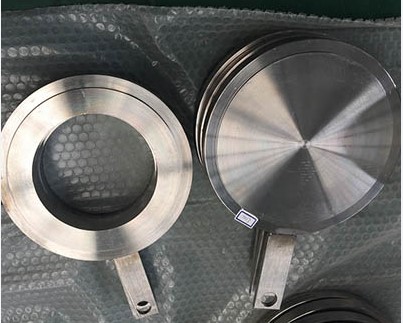
Although spade flanges and ring spacer flanges look similar, structural details determine their functional positioning. Understanding the structural differences and functional principles of both is the foundation for correct selection and use. The following explains their specific construction and working mechanisms.
The spade flange consists of two discs of the same size, which can be used separately or in combination according to actual needs. The edges of the discs have small round holes, which can interlock with other components to achieve reliable fixing. The smooth surface of the spade flange facilitates cleaning and maintenance, making it particularly suitable for applications where keeping the pipeline interior clean is required.
The main function of the spade flange is to block fluid flow in the pipeline system. When the pipeline needs to be closed, the spade is installed between the two end flanges and secured with bolts to form a reliable sealed isolation. The thickness of the spade flange is specially designed according to the pipeline's pressure rating and diameter specification to ensure it can withstand the corresponding pressure load.
The ring spacer flange is usually machined from a single piece of metal material and cut to size according to the pipe diameter. Unlike the spade, the ring spacer has a central through-hole structure, and when installed between two end flanges, it does not obstruct fluid flow, functioning effectively as a short pipe section. The outer diameter of the ring spacer is completely consistent with the spade flange, allowing both to be interchangeably installed between the same pair of flanges.
When installing a ring spacer, additional gaskets are required to ensure the sealing performance of the flange connection. When the pipeline needs to remain open, the ring spacer is installed; when closure is required, it is replaced with a spade.
Both spade and ring spacer flanges are equipped with steel handles that protrude outward from the installation position, which is the most intuitive distinguishing feature. The handle design serves multiple purposes:
- Operational Convenience: The handle provides a gripping point for field operators, facilitating handling, positioning, and installation of these relatively heavy metal components.
- Status Identification: After installation between two flanges, the main body cannot be directly observed, so the handle becomes the only visible indicator of the pipeline's current state. To distinguish them, smaller ring spacer handles usually have holes, while spade or paddle blind handles do not. For larger components, the handle may adopt different shapes or special markings for differentiation.
- Information Marking: According to industry regulations, the handle must be engraved with the diameter specification and pressure rating of the spade or ring spacer. This marking requirement also applies to spectacle blinds. Clear markings help ensure the correct component is selected, preventing safety risks due to mismatched specifications.
Installation and replacement of a spade or ring spacer flange are relatively straightforward but must strictly follow specifications to ensure safety:
Installation Position: Install the spade or ring spacer between two pipe flanges and fix it with flange bolts. Ensure the flange sealing surfaces are clean and intact before installation.
Status Switching Operation: When switching the pipeline from open to closed state (or vice versa), the operation steps are as follows:
- Loosen all flange bolts.
- Temporarily remove about half of the bolts to provide space for replacement.
- Remove the currently installed spade or ring spacer.
- Install the other component.
- Replace the gasket (using a new gasket is recommended to ensure sealing reliability).
- Reinstall all bolts and tighten to specified torque.
Bolt Length Adjustment: When installing a spade or ring spacer between flanges, the additional metal thickness may make the original bolt length insufficient. Depending on the pipeline class and blind size, bolts may need to be adjusted or replaced with longer ones to ensure adequate thread engagement and connection strength.
Material selection for spade and ring spacer flanges follows the principle of matching the pipeline system, typically manufactured from the same material specifications as the pipeline to ensure compatibility with the fluid or gas and prevent issues such as electrochemical corrosion. Common materials include:
- Carbon Steel: Suitable for general industrial pipeline systems, low cost, good mechanical properties, and the most common choice.
- Stainless Steel: Used for corrosive media or high sanitary requirements, such as in food, pharmaceutical, and chemical pipelines in contact with corrosive fluids.
- Alloy Steel: Used for high-temperature and high-pressure conditions, such as power plant pipelines and petrochemical installations, with excellent strength and heat resistance.
Material selection must consider the nature of the pipeline medium, operating temperature, pressure, and external environmental conditions.
Based on specific application needs, spade and ring spacer flanges have the following main types:
- Blind Spade: Solid plate design, used to completely isolate a pipeline section and block all fluid flow. This is the most basic and commonly used type.
- Paddle Spade: Paddle-shaped design, capable of partial flow diversion, suitable for cases where flow adjustment rather than full cutoff is required.
- Ring Spacer: Circular opening design, used to keep the pipeline open while occupying the same installation space as a spade, facilitating interchangeable use.
Design, manufacture, and inspection of spade and ring spacer flanges must comply with relevant industry standards to ensure product quality and interchangeability. Key standards include:
ASME B16.48: An important industry standard for pipeline blind flanges (including spade, ring spacer, and spectacle blind), specifying dimensions, tolerances, material requirements, and inspection standards. Compliance ensures parts from different manufacturers have uniform dimensions and performance, guaranteeing compatibility across different pipeline systems.
In addition to ASME standards, there may be additional requirements in specific industries or regions, such as API standards for oil and gas or chemical-specific regulations. The applicable standard system should be clarified when selecting and purchasing.
Spade and ring spacer flanges are widely used in multiple industrial sectors:
- Oil & Gas: One of the most important application fields for spade flanges. In oil and gas extraction, transportation, and refining, pipelines require periodic maintenance, inspection, or modification, and spade flanges provide reliable isolation. Their high-pressure, high-temperature, and corrosion-resistant characteristics make them particularly suitable for oil and gas pipeline environments.
- Chemical Industry: Many pipelines in chemical facilities require regular maintenance; spade flanges are used to safely isolate specific sections during inspection, preventing leakage or cross-contamination of hazardous media.
- Power Industry: High-temperature and high-pressure steam pipelines in thermal and nuclear power plants extensively use spade flanges for isolation, ensuring maintenance safety.
- Water Treatment Systems: Including municipal water supply, wastewater treatment, and industrial water circulation systems, spade flanges control water flow and facilitate pipeline maintenance and system modifications.
- Marine and Offshore Engineering: Offshore platforms and ship pipeline systems often adopt spade flanges due to space constraints and maintenance difficulties to achieve reliable isolation.
Spade and ring spacer flanges are widely used in industrial piping systems not only because they meet isolation needs but also because they offer multiple practical advantages, covering installation convenience, cost, and maintenance efficiency:
- No Welding Installation: Compared with some traditional pipeline isolation methods, spade flanges do not require welding, providing multiple benefits: faster installation, no need for specialized welding equipment or certified welders, no heat-affected zone impact on material performance, eliminating fire risk in flammable environments, and easy disassembly and replacement without pipeline damage.
- High Durability and Reliability: Sturdy design provides additional strength and stability to the pipeline structure. Smooth surfaces facilitate cleaning, reduce fluid resistance (when in ring spacer state), and minimize fouling. High-quality materials and reasonable design allow long-term resistance to high pressure, high temperature, and corrosive media, with a service life comparable to the pipeline.
- Multi-Functionality: Spade flanges are flexible in application. When used as a blind flange, they close the pipeline; in spectacle flange applications, they can serve as reducing flanges; when flange spacing adjustment is required, they increase the distance between two flanges. This reduces the variety of flanges needed onsite, saving time and cost.
- Economical and Accessible: Readily available in the market, with relatively low manufacturing cost. Its versatility reduces the need to purchase other specialized flanges, lowering overall project cost. Standardized design ensures good interchangeability among manufacturers, facilitating procurement and inventory management.
- Flexible Use: Suitable for different pipe diameters and materials, aiding integration of new systems with existing pipelines and retrofits.
- Easy Maintenance: Simple design with no complex internal structures, easy to inspect, clean, and replace. Maintenance costs and operational difficulty are effectively controlled. Replacement requires only loosening bolts, without cutting or welding.
In practice, choosing between spade/ring spacer flanges and spectacle blinds requires consideration:
- Application Scenarios: For large-diameter pipelines that do not require frequent status changes, split spade and ring spacer flanges are preferred. For small-diameter pipelines needing frequent flow changes, integrated spectacle blinds are more convenient.
- Weight and Operation: Spade and ring spacer components are handled separately, lighter, and suitable for manual operation. Spectacle blinds are heavier, requiring lifting equipment for large diameters.
- Cost: Split structures generally have lower manufacturing costs but require separate storage. Spectacle blinds are more complex, more expensive, but stored as a single unit.
- Space Occupation: Spectacle blinds, when switched, have a blind part protruding from the pipe side, requiring installation space. Spade and ring spacer replacement requires complete removal of one component, with corresponding work space needed.
Spade and ring spacer flanges are important isolation components in piping systems. With reliable functionality, easy installation, and good economy, they are widely used in oil and gas, chemical, power, water treatment, and other industries. Understanding their structural principles, mastering correct installation methods, and following technical standards are key to ensuring safe and reliable operation. In engineering design and field application, choosing spade, ring spacer, or spectacle blind flanges based on pipeline specifications, operation frequency, and maintenance needs optimizes pipeline safety and economy, providing strong support for the safe and stable operation of industrial production.
