What Is a Steel Beam? Types, Functions & Applications
A steel beam is a structural steel member used to span horizontal spaces and carry loads. In modern construction and engineering, steel beams are present across almost every sector, ranging from warehouses and bridges to commercial buildings and various industrial facilities. They form the essential skeleton of structural systems and serve as one of the most important load-bearing components in engineering design.
Steel beams are generally produced through rolling processes that form specific cross-sectional shapes. The main purpose of these shapes is to maximize load-bearing capacity while minimizing material consumption. Common steel beam cross-sections include wide flange beams (H-beams), standard I-beams, small I-beams, and T-beams. Each structural form is optimized for different engineering needs, such as floor systems, roof structures, or equipment support applications.
The reason steel beams commonly adopt I-shaped or H-shaped cross-sections is based on structural mechanics and engineering optimization. In these designs, the flanges primarily resist bending stresses, while the web primarily resists shear forces. This division of mechanical functions allows steel beams to carry large loads efficiently while using relatively less material, significantly improving overall structural performance and efficiency.
Steel beams are widely used in modern engineering because of their outstanding performance advantages. These characteristics allow steel beams to maintain stable and reliable operation under various complex working conditions, while also balancing economic efficiency and construction convenience. The core performance characteristics of steel beams are mainly reflected in the following aspects:
Steel beams have a very high load-bearing capacity and an excellent strength-to-weight ratio. They can ensure structural safety while reducing overall material usage. Compared with concrete and wood, steel has a significantly higher strength-to-weight ratio. This means steel beams can support greater loads while maintaining a lighter structural weight, thereby improving the efficiency of the entire structural system.
Steel beams have outstanding span capabilities. They can achieve long-span structural coverage without the need for intermediate supports. This makes them especially suitable for open spaces, large industrial workshops, warehouses, and similar structures where uninterrupted interior space is required.
Steel beams are manufactured according to strict industrial standards, which ensures stable strength, good straightness, and highly predictable mechanical performance. This reliability allows engineers to design structures with greater confidence in safety and performance. Steel beams can also be effectively integrated with columns, trusses, floor systems, and concrete structures to form complete and stable structural frameworks.
Steel beams have a long service life and relatively low maintenance requirements. Under proper protective conditions, they also exhibit good fire resistance performance. In addition, steel beams have strong resistance to deformation and are not prone to cracking or brittle failure, which further enhances their durability and long-term stability.
Steel beams are easy to cut, weld, and process, giving them excellent adaptability for different engineering requirements. At the same time, steel is a recyclable material. Steel beams can be fully recycled without significant loss of strength or material quality, making them environmentally friendly and aligned with modern sustainable development principles.
The performance advantages of steel beams allow them to meet a wide range of engineering needs. Different types of steel beams are designed with variations in cross-sectional shape and mechanical properties to suit specific application scenarios. Understanding the characteristics and uses of each type is essential for proper structural selection.
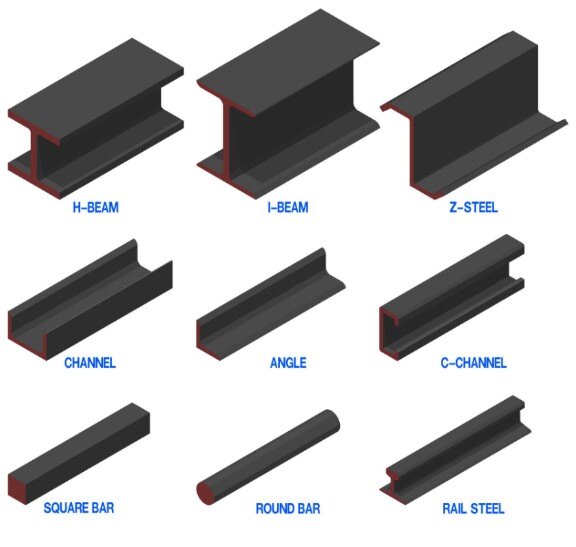
I-beams are the most commonly used structural steel beams. Their cross-section resembles the letter “I,” which is the origin of their name. They are also commonly referred to as universal beams and are widely used in various building structures.
An I-beam consists of two horizontal flanges connected by a vertical web. This structural design enables the beam to provide effective vertical support while achieving a balance between material usage and structural efficiency. Due to their simple structure and stable performance, I-beams are widely used in construction engineering and are one of the most fundamental load-bearing components.
H-beams are one of the strongest types of steel beams. Their cross-section resembles the letter “H.” They consist of wider flanges and a thicker web, resulting in a more robust structure and stronger load-bearing capacity.
Due to their excellent bending resistance and structural stability, H-beams are widely used in high-rise buildings, industrial plants, and civil engineering structures. They are particularly suitable for applications requiring high load-bearing performance. In steel roof structures, H-beams are also among the most commonly used beam types.
W-beams have a structural form similar to I-beams, but their flanges and web are wider, allowing them to carry greater loads. Because of their larger cross-sectional dimensions, W-beams also have a higher overall weight.
W-beams are commonly used in bridge and highway engineering because of their ability to support large loads. They are also frequently used in commercial and residential buildings where higher structural strength is required. Despite their heavier weight, they remain a reliable and widely used structural option.
T-beams have a cross-sectional shape resembling the letter “T.” They are usually used in structural positions where I-beams cannot be installed, such as floor beam systems.
T-beams offer strong structural performance, particularly in bending resistance and load-bearing capacity. They are commonly used in bridge construction and other heavy-duty engineering projects. Due to their ability to reduce deflection and deformation, T-beams perform especially well in long-span structural systems and are less prone to sagging.
C-beams have a “C”-shaped cross-section. Their upper and lower flanges, together with the web, form a C-shaped structural profile that provides good load-bearing capacity and stable support performance.
These beams are commonly used in bridge structures. However, due to their unique structure and open design, they can also replace wide flange beams in many applications, reducing the number of components and simplifying installation. In addition to structural applications, C-beams are widely used in support brackets, cladding systems, grid supports, reinforcement ribs, structural strengthening, and decorative frameworks, offering high flexibility.
- Universal Columns: Typically square-shaped structural members used for both large and small load-bearing structures.
- Angle Steel (L-Beams): Mainly used in lightweight construction projects.
- PFC Beams (Parallel Flange Channels): Commonly used in structural framing systems.
- Tapered Flange Beams: Similar to I-beams but with tapered lower sections, suitable for lightweight residential structures.
- HSS (Hollow Structural Sections): Hollow steel sections that can be manufactured in various shapes and sizes. They not only provide good load-bearing capacity but also allow internal routing of cables and pipelines, improving construction efficiency and space utilization.
The manufacturing process of steel beams mainly includes several key stages:
- Smelting and Casting: Iron ore is used as the raw material and is refined in blast furnaces. The molten steel is then cast into beam billets.
- Rolling and Cutting: The steel is processed through rolling and cutting to achieve the required dimensions and shapes.
- Welded Fabrication: Steel plates can be welded together to produce customized steel beams, meeting special engineering requirements.
- Hot Rolling Forming: Steel is heated and passed through rolling mills to form the final beam shape. This process ensures dimensional accuracy and structural consistency.
Steel beams offer several significant advantages in the construction industry:
- Very high strength and load-bearing capacity
- Good fire resistance and corrosion resistance, extending service life
- Stable performance even under harsh weather conditions
- Wide range of specifications, customizable designs, and cost-effective maintenance
- Resistance to damage from insects or rodents, improving long-term reliability
Compared with other construction materials, steel structures also demonstrate higher energy efficiency during production. This helps reduce overall carbon emissions in construction projects, making steel beams more aligned with modern green building development trends.
Due to differences in structural performance, various types of steel beams are used in different engineering fields. From buildings to bridges, from industrial systems to transportation infrastructure, steel beams are widely applied in modern construction.
Steel beams are widely used in high-rise buildings, warehouses, and commercial structures. Steel frame systems consist of beams and columns connected by welding or bolts, forming a stable spatial structure capable of resisting vertical loads, wind loads, and seismic forces.
Steel beams are widely used in bridge construction due to their high load-bearing capacity. Globally, millions of tons of welded steel beams are used annually in bridge projects, making bridges one of the most important application areas.
In industrial facilities such as factories and refineries, steel beams are used for equipment support structures, overhead crane systems, pipe racks, and heavy machinery foundations.
In ship construction, steel beams are used in decks and structural support systems. Key components such as hulls, decks, and trusses are commonly made using welded steel beams.
Steel beams are also used in trailers, railway systems, and truck frames due to their strength and durability.
Steel beams are widely used in overpasses, parking structures, public facilities, and transportation hubs, forming the backbone of modern infrastructure systems.
In steel structure engineering, selecting the appropriate steel beam type is crucial. Different structural members have different mechanical properties and application scenarios. Proper selection directly affects safety, economy, and overall structural performance.
Key selection considerations include:
Load Requirements: Select beam types based on expected structural loads
- Span Requirements: For long spans, H-beams or T-beams are preferred
- Space Constraints: C-beams or T-beams can be used where installation space is limited
- Cost Efficiency: Consider material, fabrication, and installation costs comprehensively
- Special Functional Requirements: For internal routing of pipelines or cables, HSS hollow structural sections are recommended
Steel beams are indispensable materials in modern construction and engineering. With their excellent strength, reliability, and diverse forms of application, they play a critical role in global infrastructure development.
From the versatility of I-beams to the high load-bearing capacity of H-beams and W-beams, from the long-span advantages of T-beams to the flexible applications of C-beams, each type of steel beam plays an irreplaceable role in modern structural systems.
The advantages of steel beams—high strength, long service life, low maintenance cost, and excellent recyclability—make them an efficient, economical, and reliable structural solution. Whether used in large commercial buildings or heavy industrial systems, steel beams remain a fundamental material supporting modern construction and infrastructure development.
Choosing the correct type of steel beam is essential for ensuring structural safety and efficiency. A clear understanding of different beam characteristics helps engineers and designers make more informed and rational decisions in engineering projects.
