Everything You Need to Know About Dual Plate Check Valves
In industrial piping systems, the prevention of fluid backflow is a critical engineering requirement. Backflow can lead to equipment damage, system instability, energy loss, and in severe cases, serious safety incidents. Among various types of non-return devices, the dual plate check valve has become one of the most widely used solutions due to its compact structure, fast response, low pressure loss, and reliable sealing performance.
This article provides a comprehensive and in-depth explanation of the dual plate check valve, covering its structure, working principles, technical advantages, application fields, and selection considerations, offering a complete reference for engineers and technical professionals.
The dual plate check valve, also commonly referred to as a double door check valve or wafer-type check valve, is an automatic valve designed to allow fluid to flow in only one direction while preventing reverse flow in pipelines.
Unlike traditional swing check valves that rely on a single disc, the dual plate check valve uses two symmetrical semi-circular plates. These two plates are installed on a central hinge mechanism and operate simultaneously, opening and closing around a shared central axis.
The “dual plate” design resembles a pair of doors. When forward flow occurs, the fluid pressure pushes both plates outward, allowing passage through the valve. When flow stops or reverses, the plates quickly return to the closed position under the combined action of spring force, gravity, and reverse pressure, effectively blocking backflow.
Structurally, most dual plate check valves adopt a wafer-type configuration. This means the valve is installed between two pipeline flanges without requiring additional long-body structure. As a result, the valve is lightweight, compact, and highly suitable for installations where space is limited.
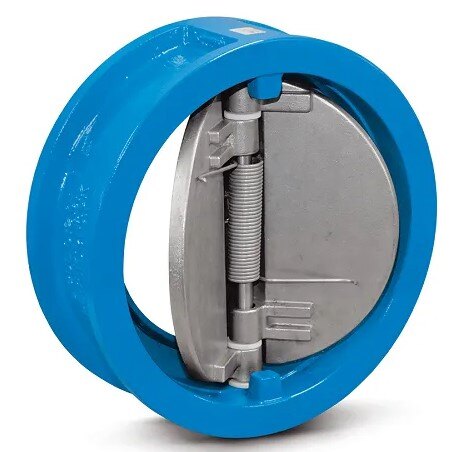
The operation of a dual plate check valve is based entirely on pressure differential in the pipeline. It does not require external energy or manual operation. Its working cycle can be divided into three stages: forward flow, closing, and sealing.
When fluid begins to flow in the correct direction, pressure builds up on the upstream side of the valve. This pressure acts evenly on the back surfaces of the two valve plates.
Once the pressure force exceeds the resistance generated by the torsion springs (if installed), the self-weight of the plates, and friction at the hinge, the plates begin to rotate outward around the central hinge pin.
As flow rate increases, the opening angle of the plates increases accordingly. Eventually, the valve reaches a fully open position, where both plates are pressed close to the internal wall of the valve body.
In this fully open condition, the flow path becomes almost unobstructed. Compared to traditional single-disc check valves, the dual plate structure provides a more streamlined flow passage, significantly reducing turbulence and energy loss.
Industry data shows that dual plate check valves typically exhibit 30%–50% lower flow resistance compared to swing-type check valves under similar operating conditions. This directly translates into reduced pumping energy consumption and improved system efficiency.
When the flow rate decreases, stops, or begins to reverse, the valve enters the closing stage. This process is highly dynamic and involves multiple forces acting simultaneously.
First, the torsion springs mounted on the hinge system play a major role. During the opening process, these springs are compressed or twisted, storing mechanical energy. When flow decreases, this stored energy is released, forcing the plates to rotate back toward the closed position.
Second, the self-weight of the plates assists the closing motion, especially in horizontal pipeline installations. Gravity naturally helps the plates return to the seat.
Third, reverse fluid pressure accelerates the closing process. As soon as backflow begins, even at very low velocity, the reverse pressure acts directly on the front surface of the plates, pushing them firmly toward the valve seat.
The combined effect of spring force, gravity, and reverse pressure ensures extremely fast closure. This multi-force mechanism is one of the key advantages of dual plate check valves over traditional gravity-dependent designs.
In many cases, the valve begins closing before reverse flow fully develops, which significantly reduces the risk of backflow and system instability.
Once the plates reach the fully closed position, reverse pressure continues to act on them, pressing them tightly against the valve seat. This creates a self-reinforcing sealing effect known as pressure-assisted sealing.
The sealing performance improves as backpressure increases, meaning the valve becomes more secure under higher reverse pressure conditions.
The valve seat design may vary depending on application requirements:
Metal-to-metal sealing is used for high-temperature and high-pressure applications where durability is critical.
Soft sealing materials such as rubber or PTFE are used in applications requiring zero leakage, such as water systems or chemical pipelines.
In some advanced designs, replaceable seat rings are used to extend service life. When wear occurs, only the seat needs replacement rather than the entire valve body.
Although the dual plate check valve is compact in appearance, its internal structure is precisely engineered. Each component plays a vital role in ensuring performance, reliability, and service life.
The valve body is the main structural element and provides the overall framework of the valve. It is typically designed in a wafer configuration with a thin, disc-like profile.
Common materials include:
- Cast iron (for water supply systems)
- Carbon steel (for general industrial use)
- Stainless steel (for corrosive or high-purity media)
- Duplex stainless steel (for aggressive chemical environments)
The internal surface of the body includes flow channels and seat mounting areas, while the external sides are designed to fit between pipeline flanges.
The two semi-circular plates are the core moving elements of the valve. Their design directly affects performance such as flow efficiency, sealing reliability, and service life.
These plates are typically made of stainless steel, duplex steel, or bronze, depending on the working environment. In severe service conditions, hard-facing materials may be applied to improve wear resistance.
Precision machining is required to ensure that the plates align perfectly with the valve seat during closure, minimizing leakage.
The hinge mechanism consists of a central hinge pin and supporting bushings. It acts as the pivot point for the opening and closing motion of the plates.
To reduce friction and wear, self-lubricating bushings or bearings are often used. Some advanced designs use a non-through shaft structure, where the hinge pin does not penetrate the external valve body. This improves structural integrity and reduces the risk of external leakage.
The torsion spring system is responsible for ensuring fast and reliable closure. It is one of the most important performance-enhancing components in the valve.
Spring materials vary depending on operating conditions:
Stainless steel springs for general applications
Heat-resistant alloy springs for high-temperature environments
Special alloys such as Hastelloy for highly corrosive media
The spring preload is carefully calculated. If too strong, it increases opening resistance; if too weak, it reduces closing speed. Proper balancing is essential for optimal performance.
The valve seat provides the sealing surface for the plates. It may be integrated into the valve body or designed as a replaceable ring.
Replaceable seat designs improve maintainability and extend service life. When the sealing surface wears out, it can be replaced independently.
Rubber-lined seats are commonly used in water applications, while metal seats are preferred in high-pressure, high-temperature environments.
The widespread use of dual plate check valves is mainly due to their strong technical advantages compared to other types of check valves.
The wafer-type design significantly reduces the face-to-face dimension of the valve. Compared to traditional swing check valves, the length can be reduced by 50%–75%.
This compact structure is especially valuable in shipbuilding, power plants, and industrial facilities where space is limited.
The dual plate structure provides a streamlined flow path with minimal obstruction. When fully open, the plates are positioned against the valve body walls, allowing fluid to pass smoothly.
This results in low pressure loss and improved energy efficiency. In long-distance or high-flow systems, this advantage can lead to substantial energy savings.
Water hammer is a destructive phenomenon caused by sudden changes in flow velocity. It can lead to pipeline vibration, noise, and equipment failure.
Dual plate check valves respond extremely quickly to flow reversal. The spring-assisted mechanism ensures that the plates close before significant reverse flow develops.
As a result, water hammer effects can be reduced by up to 60%–80%, significantly improving system safety.
The valve can be installed in both horizontal and vertical pipelines (with upward flow in vertical installation). Its performance does not depend on gravitational orientation due to the spring-assisted closing mechanism.
This flexibility simplifies piping design and makes it ideal for retrofit projects.
The simple structure and low number of moving parts result in high reliability and low maintenance requirements.
Wear is minimized due to controlled closing motion, and some designs allow internal inspection without removing the valve from the pipeline.
The dual plate check valve is widely used across multiple industries due to its versatility and reliability.
- Water Supply and Drainage Systems: Used in pumping stations, municipal pipelines, and high-rise building water systems to prevent backflow and protect water quality.
- Oil and Gas Industry: Applied in pipelines, refineries, and storage systems to ensure one-way flow and prevent reverse rotation of pumps.
- Chemical Industry: Used for corrosive, toxic, or high-value fluids to prevent contamination and ensure safe operation.
- Power Plants: Installed in cooling water, condensate, and steam systems to protect turbines and pumps.
- HVAC Systems: Used in chilled water and cooling water loops to maintain system stability in air conditioning systems.
- Marine Applications: Widely used in ballast water, bilge, and fuel systems due to its lightweight and corrosion-resistant design.
Feature | Dual Plate | Swing Type | Lift Type | Ball Type |
Compactness | Excellent | Medium | Poor | Medium |
Closing Speed | Fast | Slow | Fast | Medium |
Water Hammer Resistance | Excellent | Medium | Excellent | Medium |
Pressure Drop | Low | Medium | High | Medium |
Suitable Size | Medium–Large | Large | Small | Small–Medium |
Installation Flexibility | High | Medium | Limited | Limited |
Cost | Medium | Medium | Low | Medium |
The dual plate check valve is a highly efficient and reliable solution for preventing backflow in modern industrial pipeline systems. Its innovative dual-disc design, compact wafer structure, and fast-acting spring mechanism make it suitable for a wide range of demanding applications.
From municipal water systems to petrochemical plants and marine engineering, it plays a vital role in ensuring safe, stable, and efficient fluid transport. With continued advancements in materials and design, the dual plate check valve will remain a key component in industrial flow control systems for years to come.