Pipe Spools in Piping Engineering: Types, Advantages & Uses
Pipe spools (Pipe Spool or Piping Spool in English) are a core component in mechanical and electrical installation engineering and industrial piping systems. In simple terms, they are pre-fabricated piping units assembled in a factory or during the early construction stage. They consist of pipes, flanges, and fittings combined into a complete component that can be directly installed as part of a fluid transportation system.
These prefabricated piping units are also referred to as pipeline spools. Unlike traditional on-site cutting and welding methods, pipe spools adopt a factory-based production model, transferring the processing work that would originally be completed on-site to a controlled workshop environment, thereby significantly improving construction efficiency and quality levels.
A complete pipe spool typically includes the following key components:
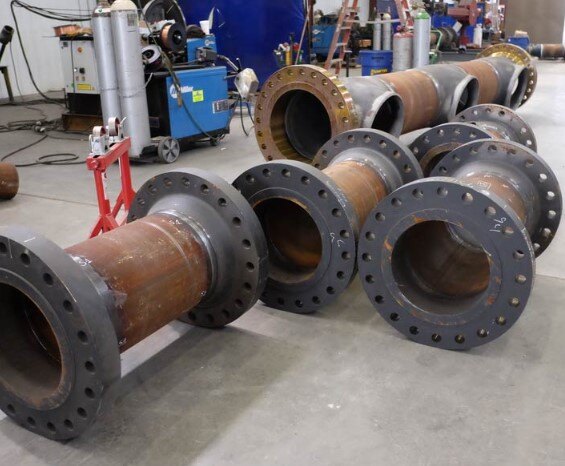
The pipe is the fundamental carrier of the spool and is used to transport various types of media. According to engineering requirements, pipe materials can be selected from stainless steel, carbon steel, alloy steel, PVC, or HDPE.
Stainless steel has good corrosion resistance and is commonly used in chemical and food industries; carbon steel has lower cost and is suitable for high-pressure conditions; alloy steel is used in high-temperature and high-pressure environments; PVC and HDPE are mostly used in water supply and drainage and wastewater treatment systems.
Flanges are key components used to connect two pipe sections, achieving a secure connection through bolt fastening. In addition to flange connections, pipe sections can also be connected using socket joints, couplings, and clamp rings. The advantage of flange connections is that they are easy to disassemble and maintain, making them one of the most commonly used connection methods in industrial piping systems.
Pipe fittings are used for branching and direction changes in piping systems, allowing fluids to be distributed to different pipelines according to design requirements. Common fittings include elbows (changing flow direction), tees (splitting or combining flow), and reducers (connecting pipes of different diameters). These fittings enable flexible layout capability for piping systems, allowing them to adapt to complex site conditions.
Supports and hangers are used to maintain the stability and alignment of the piping system, ensuring that the pipeline does not shift or deform due to vibration, thermal expansion and contraction, or external forces during operation.
Gaskets and fasteners such as bolts are used to ensure sealing performance of flange connections and prevent leakage. Gasket materials must be selected according to media characteristics, temperature, and pressure conditions. Common types include rubber gaskets, spiral wound gaskets, and graphite gaskets.
According to manufacturing location and structural characteristics, pipe spools can be divided into the following types:
Prefabricated pipe spools are fully processed and assembled in professional factories or workshops and then transported to the construction site for installation. This is currently the most widely used form of pipe spool in industrial applications, offering advantages such as stable quality, high precision, and reduced on-site workload.
When transportation conditions are limited, pipe spool dimensions are too large, or site conditions are special, some pipe spools must be assembled on the construction site. Although this method increases on-site workload, it solves construction challenges in special engineering scenarios.
Modular pipe spools adopt standardized designs, with unified interface dimensions and connection methods between units, making rapid installation and later maintenance and replacement easier. This design concept meets modern industrial requirements for efficiency and maintainability.
In small-diameter application scenarios such as instrument control systems, more compact pipe spools (Spool Tubing) or instrument tubing spools are used. These types require higher precision and are suitable for precision applications such as connecting pressure gauges, flow meters, and other instruments.
The size range of pipe spools is wide, typically from 1/2 inch to 48 inches or even larger, depending on engineering requirements and system design.
Material selection must consider the following factors:
- Media characteristics: Corrosive media require stainless steel or special alloys; food-grade media must meet sanitary standards
- Temperature conditions: High-temperature environments require heat-resistant materials; low-temperature environments must consider material toughness at low temperatures
- Pressure rating: High-pressure systems require higher-strength materials and thicker pipe walls
- Operating environment: Outdoor installation requires corrosion resistance and weather resistance considerations
The manufacturing of pipe spools follows a strict standardized process to ensure precision, strength, and quality:
Detailed spool drawings are generated based on system requirements, including isometric drawings. Dimensions, materials, and connection point locations are clearly marked. This stage also includes spatial positioning and structural planning to ensure correct installation on-site.
Pipes, fittings, and flanges are procured according to design requirements and undergo incoming inspection to ensure compliance with relevant standards. Materials are then cut and processed according to design dimensions, and pipe ends are prepared for welding.
All components are aligned and welded according to drawings. This stage requires extremely high precision, as welding quality directly affects structural stability and service life. Initial assembly is typically completed through fit-up and tack welding, followed by precise positioning and final permanent welding.
After fabrication, dimensional inspection and weld quality checks are required. Non-destructive testing methods such as X-ray and ultrasonic testing are used to verify welding quality and structural reliability. This is a key step in ensuring spool quality.
According to service environment requirements, surface treatment is applied to pipe spools, such as anti-corrosion coating, painting, or galvanizing, to improve durability and corrosion resistance.
Completed pipe spools are labeled and numbered for identification to facilitate on-site recognition and installation. They are then transported to the construction site using appropriate lifting and transportation methods.
- Reduced On-Site Construction Workload: Since most processing work is completed in factories, only connection and installation are required on-site, significantly reducing cutting and welding operations.
- Improved Quality Control Level: Factory production environments allow strict quality control, including precision equipment, professional welding processes, and comprehensive inspection systems, ensuring each spool meets design standards.
- Accelerated Project Schedule: Prefabrication can proceed in parallel with civil construction, shortening the overall project duration. On-site installation becomes faster as spools are assembled according to pre-planned schemes.
- Improved Construction Safety: Reducing on-site welding operations decreases risks such as fire, explosion, and harmful gas exposure, improving the working environment and reducing accident risks.
- Improved System Reliability: Factory-prefabricated spools have higher consistency and precision, improving installation accuracy and reducing risks of leakage or failure caused by fabrication errors, thereby improving system reliability and service life.
Pipe spools are widely used in multiple industrial sectors:
- Oil and Gas Industry: Used for transporting crude oil, natural gas, refined oil, and other media. They are a core component in oilfield development, long-distance pipelines, and refining facilities.
- Petrochemical Industry: Used in chemical production and refining processes for material transportation, requiring extremely high corrosion resistance and sealing performance.
- Power Industry: Used in steam systems and cooling water systems of thermal power plants, as well as auxiliary piping systems in nuclear power plants.
- Water Treatment Industry: Used in wastewater treatment, seawater desalination, and water supply and drainage systems, usually made of corrosion-resistant plastic or stainless steel.
- Pharmaceutical Industry: Used in high-cleanliness process piping systems, which must comply with strict GMP standards. Stainless steel is commonly used with special surface treatment.
- Food and Beverage Industry: Used for transporting raw materials, semi-finished products, and finished products, requiring strict hygiene standards and food-grade stainless steel materials.
Despite many advantages, several issues must still be considered in practical applications:
- High Manufacturing Precision Requirements: Any small fabrication error may lead to installation difficulties or misalignment on-site. Therefore, strict dimensional tolerances must be controlled during manufacturing.
- Transportation and Lifting Planning: Large spools require special transportation vehicles and route planning. During lifting, center of gravity, strength, and lifting point positions must be carefully considered to prevent deformation or damage.
- Rational Material Selection: Material selection must fully consider media characteristics, temperature, pressure, and other operating conditions; otherwise, premature corrosion, failure, or safety accidents may occur.
- Compliance with Standards and Specifications: Design, manufacturing, and inspection of pipe spools must strictly comply with international standards such as ASME, ASTM, and API to ensure safe and reliable system operation.
- Coordination of On-Site Installation: Spool installation must be closely coordinated with civil, electrical, and instrumentation disciplines to ensure proper installation sequencing and avoid rework or delays.
When selecting a pipe spool supplier, it is recommended to focus on the following aspects:
- Industry experience and technical capability: Prefer manufacturers with extensive project experience and advanced manufacturing technology
- Quality management system: Whether a complete quality management system is established and whether full quality documentation can be provided
- Inspection capability: Whether non-destructive testing, pressure testing, and other inspection methods are available
- Custom design capability: Whether customized solutions can be provided according to project requirements
- Standard compliance: Whether products comply with relevant international standards and industry specifications
- Delivery capability: Whether the manufacturer has reliable production capacity and logistics organization ability for on-time delivery
Pipe spools, as a core component of modern industrial piping systems, achieve optimization in construction efficiency, quality control, and cost management through factory prefabrication.
From oil and gas to pharmaceuticals, from power generation to water treatment, pipe spools play an irreplaceable role across various industries.
For engineering projects, properly selecting spool types, strictly controlling manufacturing quality, and optimizing on-site installation processes are key to ensuring long-term stable operation of piping systems. With continuous technological development, the manufacturing precision, material performance, and intelligence level of pipe spools will continue to improve, providing more reliable and efficient piping solutions for various industries.
