Finned Tube Complete Guide: Types, Materials & Applications
Finned tubes are an important heat transfer component, also called fin tubes or ribbed tubes. They are created by processing multiple fins on the original tube surface (external or internal), expanding the tube surface, thus forming a unique heat transfer element.
The main function of finned tubes is to enhance heat transfer performance. Because the fins increase the effective heat transfer area, the equipment structure becomes more compact. In practical applications, finned tubes are widely used in boilers, air coolers, industrial waste heat recovery devices, and air conditioning systems.
The working principle of finned tubes is very simple: when the heat transfer coefficients of the fluids on both sides of the tube are unbalanced, fins are usually installed on the side with the smaller heat transfer coefficient. For example, in boiler economizers, flue gas flows outside the tube; in air coolers, air flows outside the tube; in steam generators, flue gas flows outside the tube. During design, it is preferable to place the side with the smaller heat transfer coefficient on the outside to facilitate fin installation. If the heat transfer coefficients on both sides are small, fins should be added on both sides; otherwise, the increase in heat transfer is not significant. If the heat transfer coefficients on both sides are high, there is no need to use finned tubes; threaded or corrugated tubes can be used to further enhance heat transfer.
- Spiral Finned Tubes: Spiral finned tubes are the most common type of finned tube. They feature a simple structure, easy processing, and a relatively large heat transfer area. Spiral finned tubes are widely used in air conditioning equipment and other heat transfer devices. These tubes wind fins in a spiral shape around the base tube, effectively increasing the heat transfer area while maintaining good structural stability.
- High-Frequency Welded Finned Tubes: High-frequency welded finned tubes use high-frequency current to tightly bond the fins to the base tube. This type of finned tube has high heat transfer efficiency and low contact resistance. China's finned tube production technology is relatively mature, and high-frequency welded spiral finned tubes are the most widely used, extensively applied in power, metallurgy, cement industry waste heat recovery, and petrochemical industries. The manufacturing process of high-frequency welded spiral finned tubes involves winding steel strips onto the steel tube while using high-frequency current to heat the steel strip and the tube surface to a plastic state or melting state, then completing the welding under winding pressure. This process ensures tube strength and heat transfer performance.
- Nested Finned Tubes: Nested finned tubes usually consist of a base tube and fins. They achieve heat dissipation by inserting fins into the base tube, greatly increasing the heat transfer area. Nested finned tubes are often used in household appliances such as air-source water heaters. This structure allows heat to be transferred more directly, improving overall heat transfer efficiency.
- Sleeve Finned Tubes: Sleeve finned tubes are another type of finned tube. Their advantages are simple structure and easy processing, but their heat transfer efficiency is relatively low. This type of tube is suitable for applications with lower heat transfer requirements but strict cost control.
- Twisted Finned Tubes: Twisted finned tubes are tubes with fins wound on the base tube. Their advantage is increasing the heat transfer area while reducing gas flow resistance. This design ensures heat transfer effectiveness while reducing system energy consumption.
- Corrugated Finned Tubes: Corrugated finned tubes have fins in a wavy structure, which increases the fin surface area to improve heat transfer efficiency. The wavy shape also enhances fluid disturbance, further improving heat transfer performance.
- Variable-Pitch Finned Tubes: To improve the performance of finned-tube heat exchangers, research has proposed designing evaporator finned tubes with variable pitch for low-temperature, frost-prone conditions. This design increases internal fin heat transfer area and airflow speed. Experimental results show that this improvement can increase the heat transfer coefficient of the exchanger by approximately 9.8%.
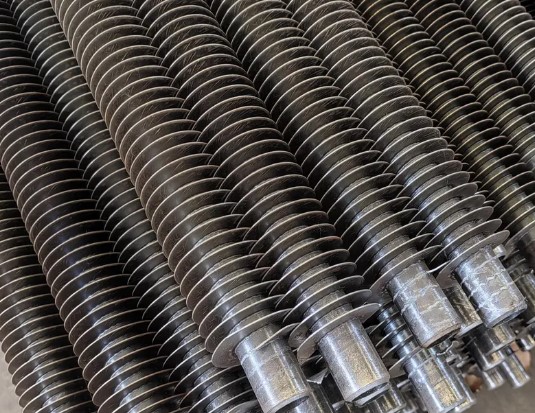
- Steel Finned Tubes: Steel finned tubes are lightweight, high-pressure resistant, and energy-efficient to produce. They have a beautiful appearance, various styles, and colors. Full-water maintenance during use can extend service life. Note that steel finned tubes are prone to oxidation and corrosion when exposed to oxygen. Open boilers and water with high oxygen content have strict requirements. Therefore, during the heating period, full-water maintenance is necessary. Without proper maintenance, the finned tubes will corrode quickly, eventually causing leakage. Consumers using open heating systems should choose steel finned tubes cautiously.
- Copper Finned Tubes: Copper convective finned tubes are corrosion-resistant but more expensive. Many consumers choose copper finned tubes due to their corrosion resistance and longer service life. Copper has good thermal conductivity, dissipates heat quickly, achieves high efficiency, and facilitates room temperature control. In addition, copper finned tubes are compact, occupy less space, and are high-efficiency and energy-saving.
- Aluminum Finned Tubes: Aluminum finned tubes are compact, have fast heat dissipation, and good anti-oxidation properties, but are easily corroded by alkali and require internal anti-corrosion measures. Currently, few users adopt them. Aluminum is lightweight, has good thermal conductivity, and is easy to form, but its corrosion resistance is relatively weak.
- Copper-Aluminum Composite Finned Tubes: Copper-aluminum composite finned tubes separate the ventilation and heat dissipation parts, utilizing copper's corrosion resistance and aluminum's lightweight, good thermal conductivity, and formability. Using copper tubes for water flow components ensures strong corrosion resistance and longer service life than ordinary steel tubes used in heating systems. Copper as the water flow component achieves higher pressure resistance and increases finned tube working pressure. Aluminum as the heat dissipation component is light, formable, and corrosion-resistant. However, composite tubes have disadvantages: fewer styles, mostly white color, and prone to deformation during long-distance transport.
- Other Materials: Depending on whether the fin material is the same as the base tube, finned tubes can be single-metal or bimetallic composite. Single-metal tubes include copper, aluminum, carbon steel, stainless steel, and cast iron or cast steel finned tubes. Different materials are suitable for different working environments and media conditions.
According to manufacturing processes, finned tubes can be divided into:
- Rolled Finned Tubes: Fins are directly rolled on the base tube to form an integrated structure. Tubes produced by this process have tight bonding and good heat transfer performance.
- Welded Finned Tubes: Includes high-frequency welding and submerged arc welding. High-frequency welded finned tubes are most widely used, with high welding quality and heat transfer efficiency. Submerged arc welding is suitable for thicker fins and tube walls.
- Rolled Formed Finned Tubes: Fins are formed by rolling; suitable for mass production and relatively low cost.
- Sleeved Finned Tubes: Pre-formed fins are sleeved on the base tube and mechanically fixed. Simple process but contact thermal resistance may be high.
- Cast Finned Tubes: One-piece casting suitable for complex shapes and special materials.
- Tension-Wound Finned Tubes: Fins are tightly wound on the base tube using tension, no welding required; suitable for special applications.
- Inserted Finned Tubes: Fins are inserted at specific positions on the tube surface, suitable for locally enhanced heat transfer.
- Fin Height: Fin height is an important factor affecting heat transfer. However, higher fins are not always better. When fin surface area doubles, the heat transfer coefficient does not double but is discounted, generally between 0.9–0.7. The higher the fin, the greater the discount, possibly falling below 0.5. This means increasing fin height reduces fin efficiency and economic performance.
- Fin Thickness: Affects strength and heat transfer. Too thin may deform or break; too thick increases cost and weight.
- Fin Spacing: Determines fin density. Excessive height or density can cause dust accumulation and make cleaning difficult. High-density fins also increase processing difficulty and cost.
- Fin Enhancement Ratio: The ratio of total heat transfer area (A) after fin addition to the base tube area (A0), A/A0. The ratio should be determined according to application and optimization. In energy engineering, generally 5–12; in air conditioning or air-cooled systems, 15–22. A reasonable ratio balances heat transfer performance and cost.
Finned tube bundles are heat exchange units composed of multiple finned tubes arranged in a specific pattern. A finned tube heat exchanger may consist of one or more bundles.
Bundle Components: Mainly finned tubes, tube sheets, and framework. Tube sheets connect both ends of the tubes, forming a continuous flow path and fixing tube spacing. Framework supports and secures the entire bundle.
Arrangement Types:
- Staggered: Tubes cross the airflow direction. Offers high turbulence and heat transfer coefficient but high resistance. Choose staggered if resistance is not strictly limited.
- In-line: Tubes are aligned sequentially. Offers lower turbulence, lower heat transfer coefficient, and lower resistance. Choose in-line if low resistance is required.
- Tube Sheet Structure: Depends on fluid pressure and heat transfer needs:
High-pressure fluids inside the tube generally use large-diameter round tube sheets, e.g., boilers.
Air coolers usually adopt rectangular boxes connecting multiple finned tube rows.
Steam condensation requires large vapor space.
When temperature difference between tube inlet and outlet is large, decomposed tube sheets should be used.
Except for the first and last rows, other rows are best connected by one-to-one bent tube connections. This improves heat transfer efficiency, reduces fluid resistance, and absorbs deformation from thermal expansion.
- Air Conditioning Systems: Widely used in evaporators and condensers. Variable-pitch fins and variable-pitch internal-threaded tubes further improve energy efficiency.
- Boilers: Finned tubes are used in water walls, economizers, and air preheaters to recover flue gas heat and improve efficiency.
- Air Coolers: Rectangular housings connect multiple finned tube rows, widely applied in petrochemical and power industries.
- Industrial Waste Heat Recovery: High-frequency welded spiral finned tubes are widely used in power, metallurgy, and cement industries to recover waste heat and reduce energy consumption.
- Household Appliances: Nested finned tubes are used in air-source water heaters. Copper-aluminum composite tubes are widely used in heating radiators.
- Petrochemical: Finned tubes are important heat transfer elements in various heat exchangers. Different process conditions require different materials and types.
After understanding types, materials, and applications, selecting suitable finned tubes in practice is critical. Selection should consider technical parameters, operating environment, and economy to avoid insufficient heat transfer or high operating costs. Specific recommendations:
- Choose Type According to Purpose: Air conditioning emphasizes efficient heat transfer and low noise; spiral or corrugated tubes are suitable. Industrial waste heat recovery has high temperature and flue dust; high-frequency welded tubes are preferred. Household appliances with limited space favor nested or copper-aluminum composite tubes.
- Choose Material According to Medium: Water quality directly affects lifespan. Poor water or open systems should prioritize copper or copper-aluminum composite tubes; good water quality with budget constraints can use steel tubes with full-water maintenance; corrosive environments require stainless steel or coated tubes.
- Focus on Core Parameters: Fin height, thickness, and spacing are critical. Excessively tall or dense fins reduce efficiency and increase dust accumulation risk. In energy engineering, fin enhancement ratio is 5–12; in air conditioning, 15–22. Verify tube diameter and pressure rating against system design.
- Emphasize Safety and Standards: For gas furnace or pressure vessel applications, check compliance with national standards and manufacturer qualifications. Purchasing from reliable sources avoids welding defects and substandard materials.
- Evaluate Cost-Effectiveness: Consider operating energy, maintenance, and service life, not just initial cost. Copper-aluminum composite tubes may have higher unit cost but lower long-term running cost than steel tubes requiring frequent replacement. Evaluate lifecycle cost for decision-making.
Finned tubes, as an important heat transfer element, play a key role in industrial production and daily life. Understanding their types, materials, design parameters, and applications helps select the most suitable products in practical projects. Proper design and selection improve heat transfer efficiency, reduce operating costs, and extend equipment life. Both engineers and end-users must master basic finned tube knowledge. This article aims to provide a comprehensive understanding to facilitate correct choices in practical applications.