Guide to Steel Pipe Coatings and Linings
In pipeline engineering, corrosion remains one of the most critical factors affecting the long-term service performance of a steel pipe. Whether the steel pipeline is buried underground for oil and gas transportation, installed above ground for water distribution, or used in industrial processing systems, unprotected steel will inevitably undergo oxidation, gradual thinning, and eventual structural failure such as leakage or rupture. To prevent these issues, modern engineering widely adopts coating and lining technologies to create protective barriers between steel and its operating environment.
This article provides a systematic and detailed explanation of steel pipe coatings and linings, including their working principles, structural types, construction processes, and application scenarios. The goal is to help readers develop a comprehensive understanding of how to select appropriate protection systems for different pipeline conditions.
Steel pipes operate under complex and often harsh environmental conditions. During long-term service, they are exposed to multiple degradation mechanisms:
For buried pipelines, the surrounding soil contains moisture, dissolved salts, and various chemical substances that accelerate electrochemical corrosion. In coastal or marine environments, chloride ions further intensify corrosion rates. Above-ground pipelines are continuously exposed to oxygen, humidity, rain, and temperature fluctuations, all of which contribute to surface oxidation.
Internally, pipelines transporting natural gas, crude oil, or industrial fluids face additional challenges. Even minor surface roughness inside a steel pipe increases frictional resistance, reducing flow efficiency and increasing energy consumption. In more aggressive environments, corrosive media can directly attack the internal wall, leading to pitting corrosion and wall thinning.
Therefore, coatings and linings serve three essential engineering functions:
- First, corrosion isolation. They physically separate steel from corrosive elements such as water, oxygen, salts, and chemicals, significantly slowing down electrochemical reactions.
- Second, hydraulic efficiency improvement. Internal linings reduce surface roughness, improving fluid or gas flow efficiency and reducing operational energy costs, particularly in long-distance transmission systems.
- Third, mechanical and environmental protection. External coatings protect pipelines from mechanical damage during transportation, installation, and soil backfilling, while also providing resistance against environmental stress and UV exposure.
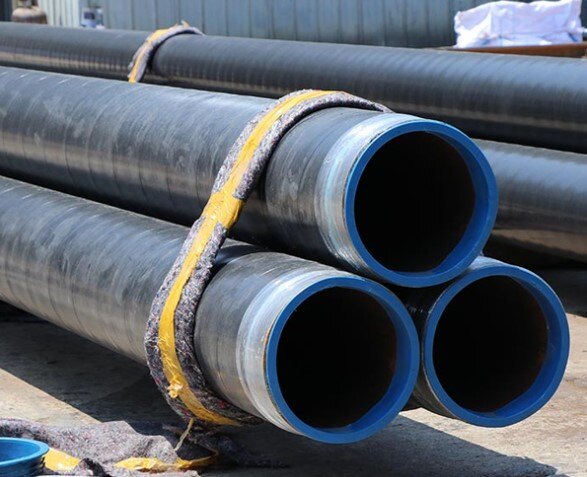
No coating system, regardless of its quality, can perform effectively without proper surface preparation. In fact, surface preparation is often considered the most critical step in the entire coating process.
The most commonly used standard is SA 2.5 abrasive blasting, which requires the steel surface to be thoroughly cleaned of rust, mill scale, oil, grease, and dust. After treatment, the surface should exhibit a uniform metallic appearance with a controlled roughness profile.
This roughness, typically ranging from 50 to 100 micrometers, is not a defect but a functional requirement. It increases the surface area available for bonding, allowing the coating material to mechanically anchor into microscopic valleys and peaks, significantly improving adhesion strength.
After blasting, the steel pipe must be carefully dried. Any residual moisture can compromise coating adhesion and create microscopic voids. In many industrial coating lines, induction heating is used to raise the pipe temperature to approximately 200–250°C. This serves two purposes: eliminating residual moisture and ensuring optimal thermal conditions for subsequent coating application.
Without proper surface preparation, even the most advanced coating systems will fail prematurely due to delamination or underfilm corrosion.
Different operating environments require different protective systems. The following sections describe the most widely used coating and lining technologies in modern pipeline engineering.
Fusion bonded epoxy is one of the most reliable and widely used anti-corrosion systems for steel pipes.
The process involves heating the pipe to approximately 240°C and applying epoxy powder using electrostatic spraying. Upon contact with the hot surface, the powder melts, flows evenly, and undergoes a chemical curing reaction, forming a continuous, tightly bonded protective film.
FBE coatings provide several key advantages:
- The first is excellent adhesion. The epoxy chemically bonds with the steel surface, forming a strong interface that resists peeling and underfilm corrosion.
- The second is strong chemical resistance. FBE coatings can withstand exposure to acids, alkalis, salts, and many industrial chemicals, making them suitable for aggressive environments.
- The third is compatibility with cathodic protection systems. Even if mechanical damage occurs, cathodic protection can continue to protect exposed steel areas.
Standard single-layer FBE coatings range from 250 to 400 micrometers and are widely used in buried pipelines, offshore pipelines, and water transportation systems. For more demanding applications requiring higher impact and abrasion resistance, dual-layer FBE systems (2FBE) are used, with total thickness reaching 600 to 1000 micrometers.
Polyethylene-based coatings are widely used due to their excellent flexibility, toughness, and impact resistance.
The process begins with blasting and heating the steel pipe to around 220°C. A thin epoxy primer layer is first applied, followed by an adhesive copolymer layer, and finally an external polyethylene jacket.
The primary function of polyethylene coatings is to form a durable physical barrier that prevents water and oxygen penetration. Their high flexibility allows them to absorb mechanical stress during pipe handling, transportation, and soil backfilling.
There are two main structural types:
- 2PE systems consist of an adhesive layer and a polyethylene outer layer. While cost-effective, they provide limited resistance to cathodic disbondment.
- 3PE systems include an epoxy primer layer in addition to adhesive and polyethylene layers. This significantly improves corrosion resistance and makes it the standard choice for long-distance oil and gas pipelines.
When pipeline operating temperatures exceed 80°C, polyethylene coatings begin to soften and lose mechanical strength. In such cases, polypropylene coatings are required.
3PP systems replace polyethylene with polypropylene, which has superior thermal stability and can operate reliably at temperatures up to approximately 110°C. This makes it suitable for hot crude oil pipelines, geothermal applications, and steam transportation systems.
The application process is similar to 3PE systems, including blasting, heating, epoxy priming, adhesive application, and outer polypropylene extrusion. Pipe ends are typically left uncoated to facilitate welding, and transition zones are sealed with protective coatings such as bitumen-based materials.
Internal linings are specifically designed to improve internal hydraulic performance.
Epoxy internal linings, applied according to API RP 5L2 standards, significantly reduce internal surface roughness. A smoother internal surface reduces turbulence and friction losses, improving flow efficiency.
In natural gas pipelines, this directly translates into lower compressor energy consumption or increased transmission capacity. In water pipelines, it improves flow stability and reduces pumping costs.
TPEP systems represent a combined internal-external protection approach designed for high-performance water transmission systems.
The internal surface is coated with FBE (300–500 micrometers), providing a smooth, hygienic, and low-resistance flow surface. The external surface is protected with a 3PE or modified polyethylene system with thickness ranging from 1.5 to 2.5 mm.
This dual-system approach ensures both hydraulic efficiency and long-term external corrosion resistance, making it ideal for municipal water supply and large-diameter pipelines.
Liquid coatings are commonly used for field applications, repair work, and above-ground pipelines where factory-applied coatings are not practical.
Internal coatings may include high-solid epoxy or ceramic-modified epoxy systems, offering thicknesses from 400 to 1000 micrometers. External systems typically use zinc-rich primers combined with polyurethane topcoats.
These systems are especially useful for bridges, offshore platforms, and structural steel applications where UV resistance and weather durability are required.
Zinc coatings differ fundamentally from organic coatings because they rely on metallic protection mechanisms.
In hot-dip galvanizing, steel pipes are immersed in molten zinc, forming a metallurgical bond. The zinc layer acts as a sacrificial anode, meaning it corrodes preferentially to protect the steel substrate.
Even when the coating is damaged, surrounding zinc continues to provide electrochemical protection. This makes galvanized steel widely used in structural applications, fencing, and general engineering systems.
Ceramic coatings are designed for extreme wear environments where abrasion is the dominant failure mechanism.
These coatings offer exceptional hardness and resistance to particle erosion. In mining slurry pipelines, power plant ash systems, and similar high-velocity solid-liquid transport systems, ceramic coatings significantly extend pipeline service life.
Although more expensive than conventional coatings, they provide unmatched durability in severe wear conditions.
Coating selection is not about superiority but suitability.
Corrosive environments require FBE or epoxy systems. High mechanical stress conditions favor polyethylene systems. High-temperature environments require polypropylene coatings. General structural applications benefit from zinc coatings. Extreme wear conditions require ceramic coatings.
Each system is optimized for specific engineering demands.
After coating application, rigorous testing ensures long-term reliability:
Holiday detection identifies coating defects and pinholes.
Adhesion testing measures bonding strength between coating and steel.
Impact testing evaluates resistance to mechanical damage.
Cathodic disbondment testing ensures coating stability under electrochemical conditions.
Thickness measurement confirms compliance with design specifications.
Porosity testing detects microscopic defects that could lead to corrosion initiation.
These tests are governed by international standards such as ISO 21809, DIN 30670, and AWWA C210.
- Pre-Insulated Pipeline Systems: In district heating and cold-region applications, pipelines require both thermal insulation and corrosion protection. These systems typically include internal coating, polyurethane insulation, and external polyethylene jackets.
- High-Temperature Systems: For operating conditions above 80°C, polypropylene or advanced dual-layer epoxy systems are required to maintain coating stability and mechanical integrity.
Coatings and linings play a fundamental role in protecting steel pipe systems and extending their operational life. Proper system selection depends on corrosion conditions, temperature, mechanical stress, and cost considerations.
With correct application, pipeline service life can be extended by decades. However, the effectiveness of any coating system ultimately depends on surface preparation, precise application, and strict quality control. Together, these elements form a complete and reliable pipeline protection strategy capable of ensuring safe, efficient, and long-term operation in diverse engineering environments.
