Hot-Dip Galvanized Steel Pipes: Principle, Process & Performance
Hot-dip galvanized steel pipes, also known as hot-dip zinc-coated pipes, are metal pipes produced by applying a zinc layer onto the surface of ordinary steel pipes through a specialized process. The core principle of this technology is to allow molten zinc to chemically react with the iron substrate of the steel pipe, forming an alloyed intermetallic layer that binds the zinc coating firmly to the base material. Compared with electro-galvanizing, hot-dip galvanizing produces a much thicker zinc coating. While electro-galvanized layers are typically only 5–15 microns thick, hot-dip galvanized coatings usually exceed 65 microns and may reach 100 microns or more, providing more durable corrosion protection.
To understand the corrosion protection mechanism of hot-dip galvanized steel pipes, it is essential to first examine the fundamental characteristics of zinc. Zinc is an amphoteric metal, meaning it can dissolve in both acidic and alkaline environments. In dry air, zinc remains highly stable with minimal chemical change. However, in humid air, a thin protective film of basic zinc carbonate forms on the zinc surface, which acts as a natural barrier against corrosion.
Despite its protective advantages, zinc may exhibit poor corrosion resistance under certain environments. Zinc coatings are vulnerable in atmospheres containing sulfur dioxide, hydrogen sulfide, or marine salts. In high-temperature, high-humidity environments with organic acids, zinc coatings are particularly susceptible to degradation. Therefore, although hot-dip galvanized steel pipes offer strong corrosion resistance, the actual operating environment must be carefully evaluated before application.
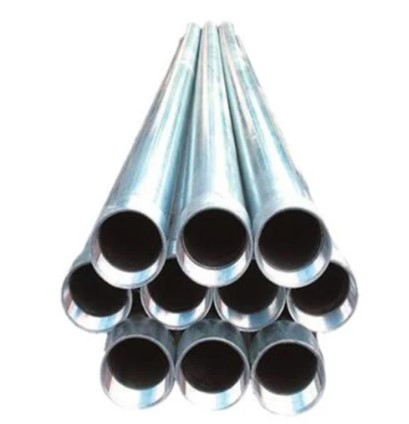
The production of hot-dip galvanized steel pipes involves multiple processing stages, including pipe inspection, acid cleaning, rinsing, flux treatment, alignment, drying, hot-dip galvanizing, external and internal air blowing, cooling, inspection, passivation, cleaning, drying, marking, spray passivation, grinding, and packaging.
After entering the production line, steel pipes must undergo surface inspection. If oil contamination is present, alkaline cleaning is required. The next critical step is acid pickling, typically using hydrochloric acid to remove oxide scale and rust from the steel surface. After pickling, rinsing is necessary to eliminate residual acid and iron salts attached to the surface.
Flux treatment is another essential step. The function of the flux solution is to thoroughly remove impurities from the steel surface, ensuring clean contact between the steel and molten zinc to form a high-quality coating. The pH value of the flux solution is generally maintained around 5. During operation, reddish-brown iron-containing compounds may form and must be filtered periodically.
Drying is also indispensable because sudden temperature changes when the pipe enters the zinc bath may cause structural cracking or bursting.
The temperature of the zinc bath must be strictly controlled at 450 ± 5 °C. This temperature range is selected based on metallurgical reaction characteristics.
Inside the galvanizing furnace, steel pipes are transported through three spiral immersion tracks. These three spirals operate at different phases, allowing the pipe to remain in an inclined posture. As the spirals rotate, the pipe moves downward along one side, gradually enters the zinc bath, and eventually slides automatically onto the track inside the zinc kettle.
When the pipe is lifted to the magnetic stirring zone, it is attracted and transferred to the traction wheel track. The subsequent external and internal air blowing processes use compressed air to remove excess zinc from the pipe surface. External blowing removes zinc from the outer surface to obtain a smooth appearance, while internal blowing clears excess zinc from the inner wall. The removed zinc droplets form zinc powder that can be recycled.
Reducing the withdrawal speed of the pipe can effectively control coating thickness and reduce zinc consumption.
The water cooling tank is maintained at approximately 80 °C to rapidly cool the galvanized pipe. Passivation treatment is then performed by spraying passivation solution onto the pipe surface to form a protective passivation film, further enhancing corrosion resistance. After passing through the external blowing ring, excess passivation solution is removed using compressed air.
Finally, the galvanized pipe is placed on the inspection platform for quality testing. Non-conforming products are removed, and qualified products are packaged for storage.
The formation of a hot-dip galvanized coating is essentially a metallurgical reaction between the iron substrate and zinc. When the steel component is immersed in molten zinc, a solid solution of zinc and α-iron first forms at the interface. This represents a crystalline structure where zinc atoms dissolve into solid iron, creating a fused atomic arrangement between the two metals.
Once zinc reaches saturation within the solid solution layer, atomic diffusion occurs between zinc and iron. Zinc atoms migrate into the iron lattice and gradually form iron-zinc alloys, while iron atoms diffusing into molten zinc react to form the intermetallic compound FeZn₁₃. Because this compound has relatively high density, it settles at the bottom of the zinc bath and forms what is commonly known as zinc dross.
When the workpiece is withdrawn from the zinc bath, a pure zinc layer is formed on the surface. This layer has a hexagonal crystal structure with an iron content not exceeding 0.003%. The combination of the alloy layer and the pure zinc layer provides excellent adhesion and superior corrosion resistance.
Excellent corrosion resistance is the most prominent advantage of hot-dip galvanized steel pipes. The zinc coating protects the steel substrate through two mechanisms. First, it provides mechanical protection by forming a dense barrier that prevents corrosive media from contacting the steel surface. Second, it offers electrochemical protection. When coating damage occurs and the steel substrate is exposed, a micro-galvanic cell forms between zinc and iron. Since zinc has a standard electrode potential of −0.76 V compared to iron’s −0.44 V, zinc preferentially corrodes as the anode while protecting iron as the cathode.
Under atmospheric corrosion conditions, protective films composed of ZnO, Zn(OH)₂, and basic zinc carbonate form on the zinc surface. This layer, sometimes referred to as white rust, slows further corrosion. Even if the protective film is damaged, a new film can gradually reform and continue providing protection.
Hot-dip galvanized coatings also exhibit good physical properties. The coating structure is dense and free from organic inclusions, with strong coverage capability. The zinc–iron alloy layer bonds firmly with the steel substrate, providing good wear resistance. Due to the ductility of zinc, galvanized components can undergo rolling, bending, cold forming, and drawing processes without damaging the coating. The pure zinc layer has plasticity close to that of pure zinc, allowing the pipe to tolerate a certain degree of deformation during installation.
In addition, hot-dip galvanizing can improve the mechanical properties of the substrate. The process functions similarly to annealing treatment, helping relieve internal stresses generated during welding or forming operations and facilitating subsequent machining processes.
Hot-dip galvanized steel pipes also offer a long service life. Because of the thick coating, strong metallurgical bonding, and comprehensive corrosion protection mechanism, their lifespan is significantly longer than that of ordinary steel pipes or electro-galvanized pipes. Although the initial cost is higher, the life-cycle economic efficiency is often superior.
Despite the advantages of hot-dip galvanizing, achieving high-quality coatings is technically challenging. Common problems such as excessive zinc dross formation, uneven coating thickness, and high production costs are usually caused by improper process control. Therefore, mastering critical process parameters is essential for ensuring product quality and reducing manufacturing costs.
Temperature is one of the most important parameters in hot-dip galvanizing. According to iron solubility behavior in molten zinc, iron loss varies significantly with temperature and holding time.
Around 500 °C, iron dissolution increases rapidly with heating and holding time, showing an almost linear growth trend. Within the range of 480–510 °C, zinc bath corrosion of both the workpiece and the zinc kettle becomes most severe. This zone is often referred to as the “critical dissolution zone.” Outside this range, the rate of iron loss slows down as temperature deviates.
When temperature exceeds 560 °C, iron loss increases again. At temperatures above 660 °C, molten zinc causes destructive corrosion to the iron substrate, resulting in rapid formation of zinc dross and making galvanizing operations impractical.
In practical production, galvanizing temperatures are generally controlled within two safe ranges: 450–480 °C and 520–560 °C.
Zinc ash and zinc dross are the main material losses during galvanizing and directly affect production cost and product quality. Zinc ash is oxide residue formed on the zinc bath surface, while zinc dross refers to iron-zinc intermetallic compounds with poor fluidity that form when iron concentration in molten zinc exceeds its solubility limit at a given temperature. Zinc dross may contain up to 95% zinc, making it a major contributor to production cost.
Typically, zinc consumption ranges from 80 to 120 kg per ton of galvanized workpieces. If zinc ash and dross formation are severe, consumption may increase to 140–200 kg per ton.
Zinc ash control mainly depends on temperature management to reduce surface oxidation. Some domestic manufacturers use refractory sand or coal ash to cover the bath surface, while foreign manufacturers often use ceramic or glass bead coverings. These materials have low thermal conductivity, high melting points, low density, and do not react with molten zinc. They help reduce heat loss and prevent oxidation while being easily displaced by workpieces.
The key to reducing zinc dross is lowering iron content in the zinc bath. Measures include avoiding galvanizing operations within the 480–510 °C critical dissolution zone, using low-carbon, low-silicon steel plates to manufacture zinc kettles (commonly 08F high-quality carbon steel with carbon content of 0.087% and silicon ≤0.03%, along with trace nickel and chromium to inhibit corrosion), regularly removing dross, preventing workpieces from falling into the zinc bath, controlling iron content in flux solutions, and adding about 0.01% aluminum to improve zinc fluidity and coating brightness while reducing dross and ash formation.
The choice of zinc kettle material directly affects service life and molten zinc quality. Ordinary carbon steel should not be used for zinc kettles because it increases zinc consumption and shortens kettle lifespan. Although silicon carbide has been proposed as an alternative zinc bath material to eliminate iron loss, its forming process remains technically difficult.
Heating systems must ensure uniform temperature rise to prevent localized overheating and equipment damage, while also improving coating quality.
Hot-dip galvanizing and electro-galvanizing are two common zinc coating methods, each with advantages and limitations.
Hot-dip galvanizing provides stronger corrosion resistance, higher coating adhesion and hardness, and longer service life. It is suitable for harsh environments, particularly marine construction and industrial corrosion protection. However, it is relatively expensive, requires larger equipment and workshop space, and may cause deformation of very thin structural components.
Electro-galvanizing offers lower cost and produces a smoother surface finish, making it suitable for applications requiring high aesthetic quality but operating in less aggressive corrosive environments. However, the coating thickness is much thinner and corrosion resistance is weaker.
For applications requiring long-term atmospheric corrosion protection, hot-dip galvanizing is clearly the preferred choice.
Due to their excellent performance, hot-dip galvanized steel pipes are widely used across multiple industries.
In the construction sector, they are used in steel structures, scaffolding systems, and building pipelines. In municipal engineering, they serve in water supply, drainage, and gas transmission pipelines. In electrical and telecommunications industries, they are used for cable protection conduits and transmission tower structures. In transportation, they are applied in highway guardrails and bridge structures. In agriculture, they are used for greenhouse frameworks and irrigation pipelines. In industrial manufacturing, they are used in mechanical structures, equipment supports, and industrial piping systems.
Hot-dip galvanized steel pipes are particularly favored in marine construction and industrial corrosion protection due to their dense iron-zinc alloy layer, which provides superior corrosion resistance.
As a mature metal corrosion protection product, hot-dip galvanized steel pipes provide long-term protection through scientific processing and strict quality control. Understanding corrosion mechanisms, mastering key process parameters, and optimizing cost control are essential for both manufacturers and users.
With continuous technological advancement, hot-dip galvanizing processes continue to improve and will play an increasingly important role across more industrial fields. When selecting hot-dip galvanized steel pipes, users should consider operating environment, corrosion protection requirements, and budget constraints, and compare different protection options such as hot-dip galvanizing, electro-galvanizing, and zinc-rich coatings to choose the most suitable solution. Proper maintenance during service is also necessary to maximize corrosion resistance and extend service life.
