What's LSAW Pipe: Manufacturing, Advantages & Applications
In infrastructure construction such as petroleum, natural gas, urban gas, district heating, water supply, and wastewater treatment, the safety and economy of pipeline systems are always core considerations in engineering design. When transporting media that are high-pressure, low-temperature, or corrosive, the choice of pipeline material is particularly critical. LSAW pipes (Longitudinal Submerged Arc Welded Pipes), due to their unique manufacturing process and excellent performance, have become the mainstream solution for large-diameter, thick-walled steel pipeline applications.
Longitudinal Submerged Arc Welded pipes are welded steel pipes manufactured using a longitudinal submerged arc welding process. Their core feature is that the weld seam runs parallel to the pipe axis. By rolling medium-thick steel plates into shape and simultaneously performing submerged arc welding on both sides of the seam, a tubular structure with high strength and high sealing performance is formed.
In terms of classification, steel pipes are mainly divided into seamless steel pipes and welded steel pipes. Welded steel pipes can be further subdivided by manufacturing process into longitudinal welded pipes and spiral welded pipes. Longitudinal welded pipes, according to the welding method, are further divided into high-frequency longitudinal welded pipes (ERW) and longitudinal submerged arc welded pipes (LSAW). Among them, LSAW pipes can produce larger diameters (typically 406 mm to 1500 mm) and thicker walls, showing clear economic advantages under high-pressure conditions.
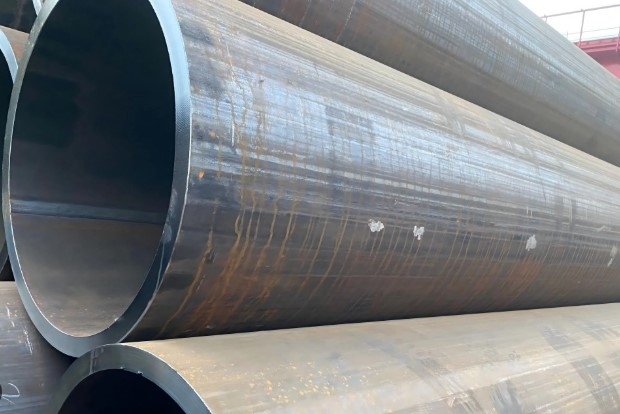
The manufacturing of LSAW pipes is a precise process involving multiple coordinated steps, mainly including the following key stages:
The raw material for LSAW pipes is hot-rolled medium-thick steel plate. After entering the production line, the steel plate undergoes full-length ultrasonic testing to ensure no internal delamination or inclusions. Subsequently, the edges of the steel plate are double-milled using an edge milling machine to accurately control the plate width, edge parallelism, and groove geometry, laying a foundation for subsequent forming and welding.
Depending on the forming equipment, LSAW pipes are mainly divided into UOE, JCOE, and other types, with the JCOE process being the most widely used:
- JCO Forming: On a JCO forming machine, the pre-bent steel plate is first pressed into a "J" shape through multiple stepwise stamping operations; the other half of the plate is pressed into a "C" shape similarly; finally, the mold combines them into an open "O"-shaped cylinder. This progressive forming method effectively controls forming stress and ensures pipe roundness.
- UOE Forming: The steel plate is pre-bent into a U shape using a U press, then closed into a circular shape with an O press, suitable for efficient production of large-diameter, thick-walled steel pipes.
Welding is the core stage of LSAW pipe manufacturing, employing a "pre-weld + final weld" double-sided submerged arc welding process:
- Pre-Weld: After the pipe is formed, Gas Metal Arc Welding (MAG) is first used to perform continuous pre-welding, fixing the seam position and providing a stable foundation for subsequent submerged arc welding.
- Internal Welding: Longitudinal multi-wire submerged arc welding (up to four wires) is performed on the inside of the pipe. Multi-wire welding allows multiple wires to work simultaneously, significantly improving deposition efficiency and welding speed.
- External Welding: Similarly, longitudinal multi-wire submerged arc welding is performed on the outside to form a double-sided full-penetration weld.
The essence of submerged arc welding lies in the "submerged" aspect: during welding, the arc burns under a granular flux layer, which melts to form slag and gas, isolating the weld pool from air while participating in metallurgical reactions to purify the weld metal. Compared with manual arc welding with flux or gas-shielded welding, this method offers more stable protection and more uniform weld quality.
After welding, the pipes undergo a series of finishing and inspection steps:
- Expansion: Mechanical expansion along the full length eliminates internal stress from forming and welding, improves stress distribution, and enhances dimensional accuracy for field welding.
- Non-Destructive Testing: 100% ultrasonic testing, X-ray industrial television inspection, etc., ensure that the welds and heat-affected zones are free of cracks, lack of fusion, or porosity.
- Hydrostatic Testing: Each pipe undergoes hydrostatic testing to verify pressure-bearing capacity, with data automatically recorded and stored.
- Pipe End Processing: Pipe ends are machined according to user requirements for field joint welding.
- Excellent Mechanical Properties: LSAW pipes undergo overall mechanical expansion, resulting in low and evenly distributed residual stress, effectively reducing the risk of stress corrosion cracking. The material is typically high-quality carbon steel or low-alloy high-strength steel, with good toughness, ductility, and uniform, dense microstructure.
- Superior Pressure Capacity: With double-sided full-penetration submerged arc welding, LSAW weld quality is close to that of the base metal, and pressure capacity is approximately 40% higher than ordinary high-frequency welded pipes. Weld reinforcement is controlled within 3 mm, weld width does not exceed twice the plate thickness, ensuring smooth transition between weld and base metal.
- Wide Specification Range: LSAW pipes can be produced in a full range from small-diameter thick-walled to large-diameter thick-walled products, typically from 16 inches (406 mm) to 60 inches (1500 mm) in diameter, with wall thickness adjustable according to engineering requirements, which ERW pipes cannot achieve.
- Good Low-Temperature Toughness: Strict material selection and process control give LSAW pipes excellent low-temperature impact toughness, suitable for oil and gas transport in cold regions or low-temperature medium transportation.
- Economic Efficiency and Production Efficiency: Compared with seamless pipes, large-diameter LSAW pipes significantly reduce production costs and improve efficiency. Although seamless pipes still dominate alloy high-pressure, high-temperature applications in China, LSAW pipes have become the most cost-effective choice in normal and medium-low temperature high-pressure fields.
Based on the above process features and performance advantages, LSAW pipes have achieved large-scale application in multiple key industries. From energy transmission to infrastructure construction, from industrial manufacturing to municipal projects, their application range continues to expand with advancements in manufacturing technology.
This is the core application market for LSAW pipes, including:
- Long-Distance Oil & Gas Pipelines: For major projects such as China's West-East Gas Pipeline, large-diameter LSAW pipes are used in some segments to handle high-pressure, long-distance, large-scale transport.
- Urban Gas and District Heating Networks: Meet urban infrastructure demands for high-pressure, high-flow transport.
- Coal Gas Pipelines: Widely used in metallurgy for blast furnace gas and coke oven gas transport.
Steel structural engineering is one of the largest sectors for LSAW pipes, mainly for:
- Building Steel Structures: Columns, trusses, and other load-bearing components in large venues and high-rise buildings.
- Bridge Engineering: Main chords and supporting components of bridges.
- Power Transmission Towers: Steel pipe towers for ultra-high-voltage lines.
Structural LSAW pipes have clear requirements for straightness, ovality, and weld quality, but compared with fluid transport pipes, their usage parameters are less restrictive.
- Pile Foundations: Deep foundation piles bearing loads from superstructures.
- Marine Engineering: Offshore platforms, docks, and other marine structure piles.
Including mechanical processing, wastewater treatment, water supply, chemical pipelines, and more. Pipes can be treated with internal and external anticorrosion coatings, such as three-layer PE or epoxy powder, to adapt to various corrosive environments.
LSAW pipe production and inspection follow strict national and industry standards, mainly including:
Weld Size Control: Weld reinforcement ≤ 3 mm, weld width ≤ 2× plate thickness, weld penetration ≥ 1 mm from base metal.
Non-Destructive Testing Requirements: 100% ultrasonic and X-ray testing of internal and external welds and adjacent base metal, ensuring no over-limit defects.
Mechanical Performance Tests: Including tensile, impact, and hardness tests to verify material strength, toughness, and weldability.
Hydrostatic Testing: Each pipe is hydrostatically tested individually, with pressure determined by standard or user requirements.
Dimensional Accuracy: Geometric dimensions such as outer diameter, wall thickness, ovality, and straightness must meet standard tolerances.
According to contract requirements, welds can also be ground flush with the base metal to meet specific appearance or hydrodynamic requirements.
Based on the above technical features and performance advantages, LSAW pipes are widely applied in multiple key industries, especially in scenarios with extremely high safety and reliability requirements.
Seamless pipes are manufactured by piercing and rolling, without welds, and are irreplaceable in ultra-high-pressure, high-temperature, and high-alloy applications. However, large-diameter seamless pipes have high production costs, low efficiency, and long delivery cycles. LSAW pipes have significant cost advantages for diameters greater than 406 mm, and quality stability can be effectively ensured through modern manufacturing processes, gradually replacing some seamless pipe applications in normal and medium-low temperature high-pressure fields.
Spiral welded pipes are formed from narrow plates with continuous spiral welding. Although they can produce large-diameter pipes, weld length increases by 30%–100%, and residual stress distribution is complex. Under the same conditions, LSAW pipes have shorter welds, more uniform stress distribution, and higher dimensional accuracy, making them especially suitable for long-distance pipelines requiring extremely high safety.
High-frequency longitudinal welded (ERW) pipes use resistance heating welding, with high production efficiency but are usually limited to smaller diameters (generally < 406 mm) and thinner walls. LSAW pipes can cover larger diameters and wall thicknesses, with deeper penetration and more reliable weld quality.
As an indispensable foundational material in modern industry, LSAW pipes play a key role in energy transmission, urban construction, and industrial manufacturing due to their mature manufacturing process, excellent overall performance, and significant economic advantages. Understanding their technical principles, performance characteristics, and application boundaries helps engineers and procurement decision-makers select the most suitable pipeline solution for specific conditions. With continuous advancements in manufacturing technology and improvement of application standards, LSAW pipes will demonstrate their unique value in more fields, providing solid material support for infrastructure construction and industrial development.
