Differences Between ERW Steel Pipes and SAW Steel Pipes
In various industrial engineering projects and infrastructure construction, the selection of pipeline systems directly affects safety, economic efficiency, and service life. Steel pipes, due to their high strength, good durability, and wide applicability, have become core materials in oil and gas transmission, urban water supply and drainage, construction engineering, and large-scale industrial systems. Among many types of steel pipes, welded steel pipes dominate the market because of their flexible specifications, controllable cost, and reliable performance.
Within the welded pipe family, Electric Resistance Welded (ERW) pipes and Submerged Arc Welded (SAW) pipes are the two most common and widely used types. Although both belong to welded steel pipes, they differ significantly in manufacturing processes, structural characteristics, performance, and application scenarios. For engineers, procurement professionals, and project managers, understanding these differences and selecting the appropriate type according to specific requirements is essential for ensuring engineering quality and controlling project costs.
This article provides a systematic comparison of ERW and SAW steel pipes from multiple perspectives, including basic concepts, manufacturing processes, performance characteristics, size applications, and cost analysis, and offers practical selection guidance to support informed decision-making in real-world applications.
ERW steel pipe stands for Electric Resistance Welded Steel Pipe. Its manufacturing process involves rolling flat steel plates into a cylindrical shape using forming equipment. High-frequency electrical current is then applied to heat and melt the edges of the steel strip, and under pressure, the edges are fused together to form a continuous longitudinal weld seam.
This welding method does not require filler materials, so there is no additional weld metal accumulation inside the pipe. ERW steel pipes offer high production efficiency, uniform weld seams, good surface quality, and high dimensional accuracy. Depending on the welding current frequency, ERW pipes can be classified into high-frequency ERW and low-frequency ERW. Small-diameter pipes typically use high-frequency welding, while larger-diameter pipes often use low-frequency welding.
The size range of ERW steel pipes is mainly from 1/8 inch to 24 inches, and in special cases, larger diameters can also be produced. Due to relatively simple manufacturing processes, ERW pipes are more cost-effective than seamless pipes. Their welding and dimensional control processes ensure consistency and uniformity, making them suitable for a wide range of fluid and gas transmission applications across various industries.
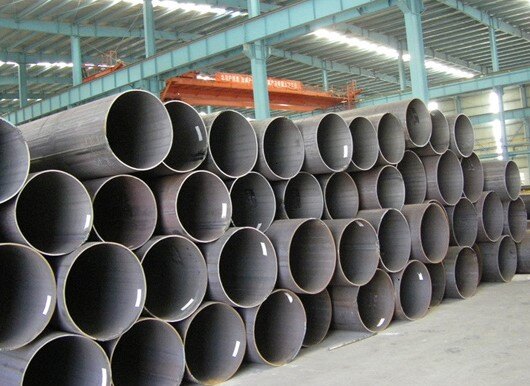
SAW steel pipe stands for Submerged Arc Welded Steel Pipe. Similar to ERW pipes, SAW pipes are also formed by rolling steel plates into cylindrical shapes. However, the welding process is different. In submerged arc welding, the weld area is covered by a layer of granular flux, and the arc burns beneath this flux layer, which is why it is called “submerged arc welding.”
SAW steel pipes mainly include two types: Longitudinal Submerged Arc Welded (LSAW) pipes and Spiral Submerged Arc Welded (SSAW) pipes. LSAW pipes have a straight longitudinal weld seam along the length of the pipe, while SSAW pipes feature a spiral weld seam along the pipe body. SAW pipes can be produced in a wide size range, from about 6 inches to 80 inches or even larger diameters.
SAW pipes are typically manufactured according to API 5L standards. They feature high weld quality, high production efficiency, and reduced arc radiation and smoke emissions. Due to the high current density in submerged arc welding, heat is concentrated in the weld zone, resulting in strong tensile strength, making SAW pipes suitable for large-scale structural and pipeline engineering applications.
The fundamental difference between ERW and SAW steel pipes lies in their welding methods, which directly affects the entire manufacturing process, from raw material to finished product. This difference determines variations in complexity, efficiency, and quality control.
The ERW manufacturing process is relatively simple. First, hot-rolled steel coils are formed into a tubular shape using forming machines. Then, high-frequency current is applied to utilize the skin effect and proximity effect, heating and melting the edges of the steel strip. Finally, pressure is applied to fuse the molten edges into a continuous longitudinal weld seam.
During welding, two copper electrodes apply pressure and current. These disc-shaped electrodes rotate as the pipe passes through, maintaining continuous contact and forming a long weld seam. Since no filler material is used, the internal surface remains smooth, making ERW pipes suitable for high-flow applications.
ERW production is characterized by high efficiency, low cost, material savings, and easy automation. It can be further classified into AC and DC welding processes. AC welding includes low-frequency, medium-frequency, super-medium-frequency, and high-frequency welding. High-frequency welding is mainly used for thin-walled or standard pipes, while DC welding is typically used for small-diameter pipes.
The SAW manufacturing process is more complex. During welding, the arc is submerged under a layer of flux, while continuous filler wire is fed externally to reinforce the weld area. Welding is usually performed on both the inner and outer surfaces to ensure strength and symmetry.
SAW pipes can be classified into single-seam and double-seam types. Single-seam pipes have one longitudinal weld. Double-seam pipes involve welding two opposite seams and generally require multiple welding passes. The process typically begins with tack welding the two halves of the pipe before completing full internal and external welding.
Spiral SAW pipes differ in that steel plates are rolled into a spiral shape before welding. This method allows flexible diameter production. LSAW pipes are commonly used in medium to high-pressure pipeline systems, while SSAW pipes are more economical and suitable for low-pressure applications.
The differences in structural characteristics and performance determine the distinct roles that ERW and SAW steel pipes are best suited to play. This division of functions is most directly reflected in their available size ranges and typical application scenarios. In many engineering projects, compatibility of specifications is often the first and most important screening criterion during material selection.
ERW steel pipes generally have smoother and flatter weld seams compared to SAW pipes. SAW welds often have internal and external reinforcement, resulting in a less uniform surface. ERW pipes typically exhibit fewer weld defects, mainly linear defects, which are easier to detect and identify.
SAW pipes may develop volumetric defects due to flux accumulation. Residual flux can affect weld integrity and may pose long-term quality risks. Therefore, ERW pipes have an advantage in weld quality control.
ERW pipes are known for good dimensional consistency and surface finish. They also tend to have lower residual stress and better deformation uniformity, resulting in stable diameter and ovality.
SAW pipes, however, have stronger weld reinforcement, offering higher tensile strength, better impact resistance, and improved durability. Double-sided welding significantly enhances structural integrity, making SAW pipes more suitable for high-pressure, high-load, and long-distance pipeline systems.
In extreme high-pressure or corrosive environments, ERW pipes are relatively limited. SAW pipes demonstrate better stability and longer service life under harsh conditions, with lower maintenance requirements.
ERW pipes are easier to repair when defects occur, as welding repairs are relatively straightforward. In contrast, SAW pipes may develop cracks or corrosion issues that are more difficult to repair. From a long-term perspective, ERW pipes may offer advantages in certain applications.
First, from a quantitative perspective, the two types of steel pipes have clearly defined limits in terms of producible diameter range, maximum wall thickness, and single pipe length. Understanding these specification differences helps quickly determine which pipe types physically meet the basic design requirements of a project.
ERW pipes are typically used for small to medium diameters, ranging from 1/8 inch to 24 inches. They are suitable for applications requiring high dimensional accuracy.
SAW pipes can be manufactured in much larger diameters and thicker wall sections, ranging from about 6 inches to over 80 inches. Spiral SAW pipes, in particular, offer flexible diameter production, making them widely used in large-scale projects.
ERW pipes are widely used in water and gas transmission, structural applications, low-pressure systems, and oil and gas pipelines. Applications include:
- Structural support and frameworks in construction projects
- Urban water supply and gas distribution networks
- Medium and low-pressure pipelines in oil and gas systems
- Aviation, aerospace, energy, electronics, automotive, and light industries
SAW pipes are widely used in large-diameter transmission systems, including:
- High-pressure oil and gas pipelines over long distances
- Large-scale water transportation systems
- Mining slurry and drainage systems
- Offshore pipelines and marine engineering structures
Additionally, SAW pipes can be coated for corrosion protection, expanding their application range.
Differences in specifications and applications inevitably lead to different economic considerations. Under the condition that technical requirements are satisfied, cost is often the key factor that determines the final selection. The following provides a systematic comparison from three aspects: manufacturing cost, transportation and installation cost, and full life-cycle cost.
ERW pipes have lower manufacturing costs due to simpler and continuous production processes. Equipment investment and welding costs are relatively low.
SAW pipes require more complex processes, filler materials, and flux, resulting in higher production costs and lower efficiency.
ERW pipes are lighter and easier to transport and install, reducing construction costs. SAW pipes require heavy lifting equipment and specialized transportation due to their large diameter and weight, increasing installation expenses.
ERW pipes are more economical in initial investment but may require more maintenance in long-term use. SAW pipes, although more expensive initially, offer longer service life and lower maintenance costs, making them more cost-effective in long-distance and critical infrastructure systems.
Selection should be based on specific engineering requirements:
For low to medium pressure systems with budget constraints, ERW pipes are preferred.
For high-pressure, large-diameter, and high-safety applications, SAW pipes are preferred.
For harsh environments such as high corrosion or extreme conditions, SAW pipes are more suitable.
Key factors include:
- Operating pressure: ERW for low/medium, SAW for high pressure
- Pipe diameter: ERW for small/medium, SAW for large
- Environmental conditions: SAW preferred for harsh environments
- Budget: ERW for limited budgets, SAW for long-term investment
- Safety level: SAW preferred for high-risk applications
ERW and SAW steel pipes are two of the most widely used welded pipe types in industrial applications. ERW pipes feature high production efficiency, low cost, smooth welds, and high dimensional accuracy, making them suitable for low to medium pressure and small to medium diameter applications. SAW pipes offer high weld strength, excellent impact resistance, and large-diameter capability, making them ideal for high-pressure and demanding environments.
There is no absolute superiority between the two. The correct choice depends on engineering requirements, operating conditions, budget constraints, and safety considerations. A comprehensive evaluation of pressure, medium, environment, and service life is essential to achieve optimal technical and economic performance.
