ERW Steel Pipes Explained: Manufacturing and Applications
In modern industrial and construction projects, steel pipes serve as critical materials for both structural support and fluid transportation, fulfilling multiple functions including load-bearing, reinforcement, conveying, and safety assurance. With the rising demands for construction efficiency, cost control, and material performance, Electric Resistance Welded (ERW) steel pipes have increasingly become a preferred choice in engineering applications due to their high production efficiency, excellent structural integrity, and cost advantages. ERW steel pipes are manufactured through a process of cold forming and electric resistance welding, offering uniform weld seams, precise dimensions, corrosion resistance, and convenient installation and maintenance. These attributes make ERW steel pipes perform exceptionally well in applications such as building structures, industrial pipelines, fluid transportation, and pile foundation support. This article provides a comprehensive analysis of ERW steel pipes, covering their definition, manufacturing process, performance advantages, application scenarios, surface treatment methods, and quality control measures, while also comparing them with seamless steel pipes, providing engineers and designers with a systematic and professional reference guide.
ERW steel pipe stands for Electric Resistance Welded pipe. It is produced by cold-forming a steel coil or strip into a cylindrical shape and then welding the edges using electric resistance. ERW steel pipes are a type of longitudinal welded pipe, with weld seams running along the length of the pipe.
Unlike ordinary welded pipes, ERW steel pipes do not require any filler metal or welding wire during the welding process. During welding, the edges of the steel are joined under applied pressure and electric current. After welding, the seam undergoes heat treatment, ensuring that the pipe sides are firmly fused, and the weld performance closely matches that of the base material.
ERW steel pipes have increasingly gained popularity in modern structural engineering due to multiple advantages, including shorter production cycles, lower material consumption, reduced labor costs, high precision, reliable quality, excellent structural integrity, and long service life.
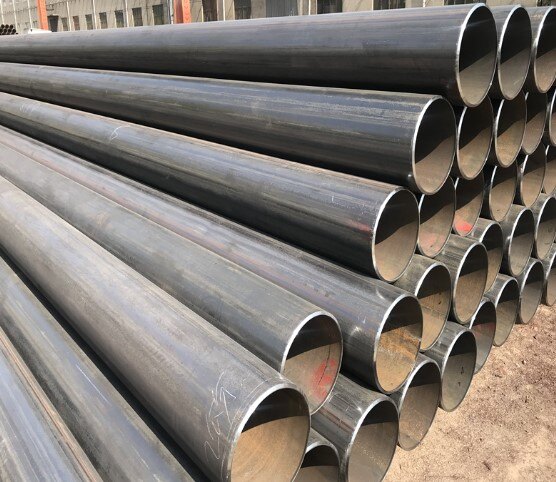
The manufacturing process of ERW steel pipes consists of several key steps, each critically affecting the final product quality.
The first step in manufacturing ERW steel pipes is selecting high-quality steel strips or coils. The specifications and material grade of the steel coil directly influence the final performance of the pipe. Manufacturers select different grades and thicknesses of steel coils according to the intended application. Before entering the production line, steel coils are processed through uncoilers and accumulator units to ensure smooth feeding into subsequent production equipment.
Cold forming is a core step in the ERW pipe manufacturing process. This process occurs at room temperature, below the steel's recrystallization temperature. The steel strip passes through a series of rollers to gradually form a cylindrical shape. During the forming stage, the cold-formed steel takes on a U-shaped cross-section, with edges remaining open.
Throughout the process, equipment ensures that the steel maintains a uniform U-shape to prevent defects or irregularities in the pipe. The steel first passes through rolling assemblies, then through forming dies to achieve a consistent U-shaped cross-section, preparing the pipe for welding.
Cold forming also helps remove material impurities, creating a denser and more uniform grain structure. This process strengthens the steel while reducing material waste during mechanical processing.
Welding is the key feature that differentiates ERW steel pipes from other types. Once the steel strip is formed into a cylinder, high-frequency electric current heats the seam edges, while induction coils provide contactless heating. High-frequency welding concentrates energy on the steel surface using the skin effect and proximity effect, ensuring the edges rapidly heat, melt, and fuse under compression.
To control current distribution, flux concentrators are often used to focus energy on the weld, ensuring uniform and efficient welding. Smooth pressure rollers maintain the cylindrical shape while welding. No filler metal or welding wire is required, resulting in uniform welds with consistent strength distribution.
The frequency of high-frequency welding typically ranges between 50 kHz and 400 kHz. Depending on the feeding method, welding can be classified into high-frequency contact welding and high-frequency induction welding.
After welding, ERW steel pipes undergo several post-processing steps. First is sizing and shaping, where the pipe diameter and shape are adjusted using sizing machines to meet design requirements. The pipes are then cut to various lengths and diameters, typically ranging from 0.5 meters to 24 meters according to application needs. End machining is performed to adapt the pipe ends for different fittings and connections.
Additional processes such as deburring and straightening are carried out to ensure pipe quality. Finally, strict inspection and testing are conducted to confirm that each pipe meets quality standards.
ERW steel pipes offer multiple advantages that make them stand out among other types of pipes.
ERW steel pipes have shorter production cycles compared to seamless or LSAW pipes, resulting in higher production efficiency. They also exhibit higher material utilization and lower labor costs, making them more competitively priced. Well-prepared pipe ends reduce welding preparation work and construction obstacles, further lowering overall project costs.
ERW steel pipes maintain high dimensional precision, with uniform wall thickness and smooth, aesthetically pleasing surfaces. Outer diameters range from ¼ inch to 18 inches, with wall thicknesses from 0.5 mm to 20 mm. Standard sizes such as Schedule 40 and Schedule 80 are widely used. Accurate dimensional control ensures stability in fluid transport and structural support.
Modern ERW welding techniques produce seams that, after heat treatment, achieve strength comparable to or even exceeding that of the base material. Heat treatment ensures firm bonding on both sides of the pipe, maintaining structural integrity and extending service life. High weld strength allows long pipe sections to be used continuously without additional supports or fasteners.
ERW steel pipes are corrosion-resistant, suitable for outdoor structures and long-term projects, such as energy infrastructure construction. They can withstand harsh environments and extreme weather conditions over extended periods without significant corrosion.
ERW steel pipes support complex pipeline arrangements, meeting diverse engineering requirements. Their cylindrical structure provides high strength and durability, and tightly connected pipe segments ensure the overall structure withstands significant pressure without deformation or collapse.
No harmful chemicals or solvents are required during production or installation, making ERW pipes environmentally friendly. This advantage is particularly relevant in projects with strict environmental standards.
ERW and seamless steel pipes are two commonly used types, with distinct differences in manufacturing and performance.
Seamless steel pipes are made from a solid steel billet, shaped into a tube through piercing and rolling, without any weld seam. This gives seamless pipes higher strength, making them suitable for high-pressure and high-temperature environments. The continuous, smooth surface also eliminates potential weak points caused by weld seams.
ERW steel pipes are produced by welding steel strips longitudinally, creating a seam along the length. However, modern ERW techniques ensure weld quality comparable to the base material. ERW pipes have lower costs and shorter production cycles, making them suitable for applications not requiring extreme pressure resistance.
Selecting the appropriate pipe depends on project requirements. For high-pressure boilers or heat exchangers, seamless pipes may be preferable. For general structural engineering and fluid transport, ERW pipes offer a more cost-effective solution.
ERW steel pipes are widely used in structural engineering due to their uniformity, cost efficiency, and ease of installation.
ERW steel pipes are commonly used in bridges, towers, and lighting poles. Their cylindrical structure provides high strength and durability, ensuring long-term performance even in harsh environments. Tight connections between segments allow the overall structure to withstand significant pressure without deformation or collapse. Therefore, ERW pipes are crucial for large-scale projects requiring reliable, durable structural support.
ERW steel pipes are used in industrial pipelines to meet various process transportation needs. Their high strength makes them key components in high-pressure and high-temperature pipelines such as boilers and heat exchangers, delivering excellent performance under diverse operating conditions.
ERW steel pipes are widely used in water supply and drainage systems, as well as in gas pipelines including coal gas, steam, and liquefied petroleum gas. They find applications across water engineering, petrochemical, chemical, power generation, agricultural irrigation, and urban infrastructure projects.
ERW steel pipes are suitable for piling, docks, roads, and building foundations. Their high strength and corrosion resistance make them ideal for pile foundation projects.
ERW steel pipes are widely used in construction scaffolding due to their high strength, light weight, and ease of installation, providing safe and reliable support during building construction.
For applications such as oil and gas pipelines, surface treatment is often required to extend the service life of ERW steel pipes. Common methods include:
Hot-dip galvanizing involves coating the pipe surface with a layer of zinc. This method provides corrosion resistance at moderate cost, with a service life ranging from 30 to 100 years. Hot-dip galvanized pipes are suitable for outdoor structures and long-term projects.
Oiling is primarily used as a temporary anti-rust measure during short-distance transportation or temporary storage. It offers short-term protection against corrosion and is convenient for logistics handling.
Painting provides long-term protection against rust and moisture. This method is cost-effective, easy to apply, and commonly used for surface protection.
This treatment is suitable for low-temperature or specialized environments. It prevents cracking under cold conditions while protecting the pipe from external corrosion. Anti-corrosion and insulation treatments are especially important for pipes used in harsh or extreme environments.
Sandblasting removes surface rust and impurities, creating a uniform roughness that improves adhesion for subsequent coatings. This process enhances the durability and effectiveness of protective coatings.
Electrophoretic coating deposits a protective film on the pipe surface through electrolysis. This treatment offers excellent corrosion resistance, comes in multiple color options, and does not require a special construction environment. However, it is relatively higher in cost compared to other surface protection methods.
Strict quality control is essential during the manufacturing of ERW steel pipes to ensure that the final product meets performance standards. These measures help detect defects or potential weak points before use, ensuring structural safety and reliability.
Magnetic Particle Inspection: Magnetic particle inspection detects surface and near-surface defects in steel pipes, such as cracks and porosity, ensuring the weld seam’s quality.
Ultrasonic Testing: Ultrasonic testing is a non-destructive method that evaluates internal defects, including weld seam porosity, slag inclusion, and incomplete fusion. This method provides a comprehensive assessment of pipe quality.
Hydrostatic Testing: Hydrostatic testing applies a specified pressure to the pipe to verify that it can withstand the design pressure without leakage or rupture. This test validates the overall strength and sealing performance of the pipe.
Dimensional and Visual Inspection: Each pipe undergoes dimensional and visual checks to ensure that outer diameter, wall thickness, length, and surface appearance meet required standards and are free from visible defects.
ERW steel pipes, manufactured through cold forming and electric resistance welding, are characterized by fast production cycles, high dimensional precision, strong weld seams, and excellent corrosion resistance. They offer a cost-effective, convenient, and reliable solution for industrial and structural applications.
ERW pipes are widely used in building structures, industrial pipelines, fluid transportation, pile foundations, and scaffolding systems. With strict quality control, they provide a safe, dependable, and efficient material choice for construction and maintenance projects.
ERW steel pipes and seamless steel pipes each have their advantages. Seamless pipes offer higher strength for extreme high-pressure and high-temperature conditions. ERW pipes are more cost-effective, have shorter production cycles, and are suitable for most conventional applications. Engineers should select pipe materials based on specific project requirements and budget considerations, ensuring optimal performance and cost-efficiency.
