Role of Sanitary Valves in Food & Pharmaceutical Processing
In modern industrial production, valves are essential fluid control devices widely used across numerous sectors. However, for industries with extremely high hygiene requirements, such as food processing and pharmaceuticals, conventional industrial valves are clearly insufficient to meet stringent sanitary standards. This is where sanitary valves come into play. Designed specifically to ensure product quality and safety, sanitary valves have become indispensable equipment in these industries. This article provides an in-depth discussion of the materials, types, manufacturing standards, applications, and key differences between sanitary valves and industrial valves, offering a comprehensive understanding of this specialized and vital product category.
The valve bodies of sanitary valves are typically manufactured from stainless steel, with SS 304 and SS 316 being the most commonly used grades. These materials offer excellent corrosion resistance, high-temperature tolerance, and strong mechanical properties, ensuring that valves do not corrode, flake, or degrade during long-term service. As a result, all media-contact surfaces remain clean and smooth.
For example, in food processing applications, valves often come into contact with acidic or alkaline media such as fruit juices or milk. The superior corrosion resistance of SS 304 and SS 316 effectively prevents material degradation and avoids the release of harmful substances that could contaminate food products.The choice of sealing materials is equally critical.
For metal-to-metal (hard) sealing, stainless steel is commonly used to ensure reliability and durability.
For soft sealing, elastomeric materials are preferred. Under operating temperatures not exceeding 140 °C, EPDM (ethylene propylene diene monomer) rubber is widely used due to its excellent heat resistance, chemical stability, and elasticity, ensuring reliable sealing under normal operating conditions.
Although fluoroelastomers (FKM) offer outstanding chemical resistance, they contain toxic components and are therefore strictly prohibited in sanitary valve applications. This restriction highlights the rigorous material selection standards of sanitary valves and their strong emphasis on health and safety.
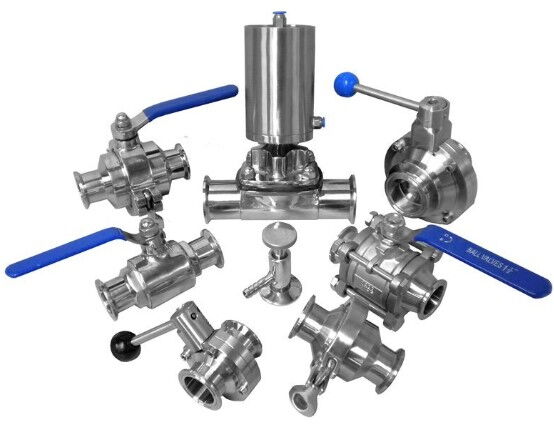
The widespread adoption of sanitary valves in the food and pharmaceutical industries is largely due to their diverse designs and distinct performance characteristics. These valves are engineered in various forms to suit different operating conditions and process requirements. The most common types include the following.
Sanitary butterfly valves feature a simple structure, compact size, and light weight. Their primary advantages are fast opening and closing and flexible operation. The disc is mounted along the pipe diameter and rotates around a central axis within the cylindrical valve body. A rotation angle between 0° and 90° controls the valve position, with 90° corresponding to the fully open state.
This design allows for quick flow regulation and rapid response to process changes. In addition, sanitary butterfly valves have a high surface finish, making them easy to clean and sterilize, fully complying with hygienic requirements.
Sanitary ball valves are named after their spherical closure element. Fluid flow is controlled by rotating the ball, enabling rapid switching between fully open and fully closed positions. These valves offer excellent sealing performance and low flow resistance.
In food and pharmaceutical applications, sanitary ball valves are widely used for material transfer and flow control. They ensure smooth fluid movement while preventing contamination. Both the valve body and ball are made of stainless steel and undergo precision machining and polishing to achieve a high surface finish. This design complies with GMP (Good Manufacturing Practice) requirements and ensures product hygiene and safety.
Sanitary check valves are automatic valves designed to prevent backflow. When fluid enters from the inlet side, the valve opens automatically to allow passage. If reverse flow occurs, the valve closes instantly to block it.
This function is particularly important in food and pharmaceutical production processes where backflow could cause contamination, such as beverage production lines and pharmaceutical equipment. The valve body and disc are made of stainless steel with smooth surfaces, facilitating cleaning and sterilization while effectively preventing bacterial growth and cross-contamination.
Sanitary diaphragm valves use an elastic diaphragm as the closure element. The diaphragm separates the valve body chamber from the bonnet chamber, controlling flow through vertical movement.
The key advantage of this design is that it prevents direct contact between the process fluid and moving components such as the valve stem. This minimizes contamination risks caused by corrosion or wear of mechanical parts. Made from stainless steel and corrosion-resistant materials, sanitary diaphragm valves feature smooth surfaces and excellent cleanability, making them ideal for high-hygiene applications such as pharmaceutical reactors and food ingredient tanks.
Sanitary valves are manufactured under extremely strict standards. The required surface roughness is typically Ra ≤ 1.6 µm, meaning the surface must be exceptionally smooth, free of scratches or irregularities. Such a finish reduces the likelihood of bacterial growth and greatly facilitates cleaning and sterilization.
A defining feature of sanitary valves is their compatibility with CIP (Clean-in-Place) and SIP (Sterilize-in-Place) systems. Without disassembling the valve, internal surfaces can be cleaned using specialized cleaning agents and then sterilized with high-temperature steam or other sterilizing media. This capability clearly distinguishes sanitary valves from conventional industrial valves.
Additionally, sanitary valves are designed with smooth transitions, no dead zones, and no crevices, effectively preventing product buildup and microbial growth. Beyond the sealing surfaces, many sanitary valves incorporate anti-mixing structures to prevent cross-contamination between different media. For example, double-seat sanitary valves use specially engineered sealing designs to prevent unintended media crossover, ensuring process safety and product consistency.
Sanitary valves and industrial valves differ significantly in several key aspects, including materials, applications, cleaning requirements, and manufacturing standards.
Sanitary valves are primarily made of stainless steel, especially SS 304 and SS 316, chosen for their corrosion resistance and hygienic properties. Industrial valves, on the other hand, may be made from a wide range of materials, including cast iron, cast steel, and ductile iron.
In terms of appearance, sanitary valves undergo precision machining and polishing, resulting in smooth, clean surfaces with no areas for media accumulation. Industrial valves generally have rougher surfaces and are not specifically polished, making them less suitable for hygienic environments.
Sanitary valves are mainly used in industries with extremely high hygiene requirements, such as food processing, pharmaceuticals, and biotechnology. Products in these industries often come into direct contact with the human body, demanding strict safety and cleanliness standards.
Industrial valves are widely applied in sectors such as machinery manufacturing, metallurgy, petrochemicals, chemicals, and municipal engineering. These applications typically involve harsh environments with high temperature, high pressure, or corrosive conditions, where mechanical performance takes precedence over hygiene.
Sanitary valves are designed for easy cleaning and maintenance. Their smooth surfaces support CIP and SIP processes, significantly reducing cleaning time and labor. Connection methods such as clamp (tri-clamp) fittings and threaded joints allow quick disassembly and reassembly, further improving maintenance efficiency.
In contrast, industrial valves are more difficult to clean due to complex structures and rough surfaces. Cleaning and maintenance often require complete disassembly, and sterilization effectiveness is generally lower.
Sanitary valves must comply with stringent international standards such as GMP, FDA, and EHEDG, covering material selection, design, manufacturing processes, and cleanability. These standards ensure superior quality and hygiene performance.
Industrial valves are typically manufactured according to performance requirements dictated by operating conditions. While industrial valves often have a longer service life under harsh conditions, sanitary valves require regular cleaning and sterilization, which may affect longevity. However, with advances in materials and manufacturing technologies, the service life of sanitary valves continues to improve.
Due to their stringent hygiene standards and high-performance characteristics, sanitary valves are widely used in industries such as food processing and pharmaceuticals. The following application examples illustrate the critical role sanitary valves play in real-world production environments.
- In food processing, sanitary valves are extensively used for fluid transfer and flow control.
- In beverage production lines, sanitary butterfly and ball valves regulate product flow and filling volumes, ensuring consistency and quality.
- In dairy processing, sanitary diaphragm valves control the transfer and batching of milk and yogurt, preventing contamination.
- In brewing, sanitary valves manage wort and beer transfer, as well as temperature and pressure during fermentation.
- These applications not only ensure food safety but also improve production efficiency and product consistency.
- In pharmaceutical manufacturing, sanitary valves play an equally critical role.
- In reactors, sanitary diaphragm valves control raw material feeding and regulate temperature and pressure.
- In mixing tanks, sanitary ball valves manage material transfer and blending to ensure drug purity and quality.
- During filling and packaging, sanitary solenoid valves precisely control filling volumes and gas delivery.
All these applications strictly adhere to GMP and other international hygiene standards, safeguarding product quality and public health.
Overall, sanitary valves, through stringent material selection, scientifically optimized designs, and a manufacturing philosophy centered on cleanability, form a vital line of defense for safe production in the food and pharmaceutical industries. In terms of material safety, sealing reliability, and CIP/SIP capability, sanitary valves significantly outperform conventional industrial valves, effectively minimizing contamination risks and ensuring product quality and regulatory compliance.
As food safety regulations and pharmaceutical quality standards continue to rise, sanitary valves have evolved from optional components into critical process equipment. Looking ahead, ongoing advances in manufacturing techniques and material science will further enhance sanitary valves in terms of cleanliness levels, service life, and intelligent control, providing even stronger support for the safe, stable, and efficient operation of the food, pharmaceutical, and biotechnology industries.
