Everything You Need to Know About Double Union Ball Valves
Double union ball valves are a widely used type of valve in modern piping systems and fluid control fields. They combine the control functionality of traditional ball valves with the convenience of union connections, featuring union connections at both ends of the valve body. This design makes installation and removal of the valve simple, without requiring extensive modifications to the pipeline system.
From a basic structural perspective, the core component of a double union ball valve is a ball with a central bore. When the ball rotates 90 degrees, the bore aligns with the pipeline, allowing fluid to pass smoothly; rotating another 90 degrees positions the bore perpendicular to the pipeline, completely cutting off the fluid passage. This on-off operation requires only a quarter-turn, making it fast and clear.
The term "double union" refers to having the same connection structure at both ends of the valve. Each union connection typically consists of a male and female connector, secured by tightening a nut. This connection method does not require cutting or threading the pipeline, nor using glue to bond the entire valve. By fixing the union adapters to the pipeline, the valve body can connect to the adapters through the union nuts.
After understanding the basic structure and working principle of double union ball valves, let’s examine their specific advantages in practical applications. These advantages make them stand out among many valve types and become a preferred control element in piping systems.
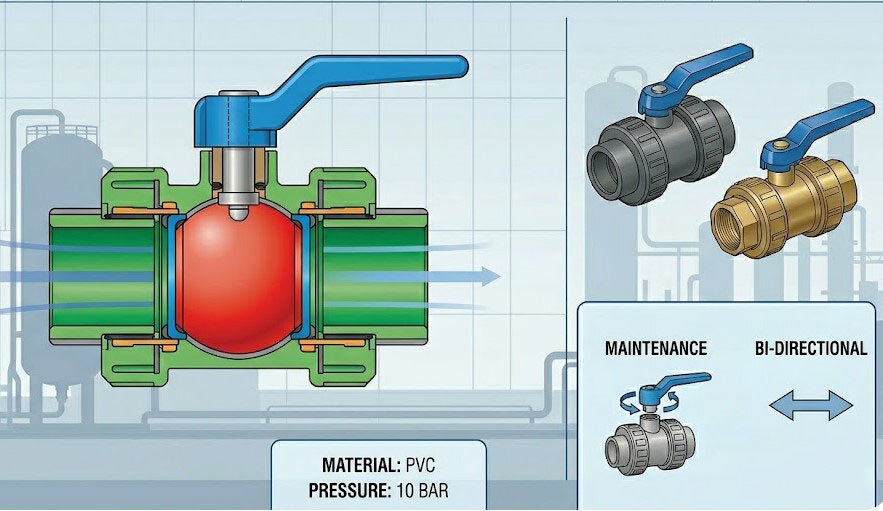
The most prominent feature of double union ball valves is the ease of maintenance. When the valve needs servicing or replacement, simply loosen the union nuts at both ends using two wrenches, and the entire valve core can be removed from the pipeline. At this point, the adapters pre-installed on the pipeline remain stationary, and the surrounding piping system is completely unaffected.
In contrast, traditional glued ball valves must have the pipeline cut for removal, which not only involves significant labor but also wastes piping material. Reinstallation requires new fittings and glue, making the entire process time-consuming. The double union design reduces maintenance time from several hours to a few minutes, significantly decreasing system downtime.
The sealing system of double union ball valves consists of multiple components. Each union contains an O-ring, usually made of flexible materials such as EPDM. When the union nut is tightened, the union seat compresses the O-ring to form a tight contact with the valve body surface, creating a reliable mechanical seal.
This sealing method does not rely on glue but is achieved through physical compression. Tests show that double union ball valves can withstand high water pressure, with stable and long-lasting sealing performance. All valves are subjected to a 10-bar pressure test and wet testing before leaving the factory to ensure the reliability of each product's seal. If users notice a small amount of water inside the valve when removing the union, it is a residue from factory testing and is considered normal.
Double union ball valves are relatively small in size and occupy little space. This feature makes them particularly suitable for installation in space-limited environments, such as densely equipped industrial plants, basement pipe wells, or ship compartments. The compact structure also means lighter weight, facilitating transportation and installation.
Double union ball valves can adapt to a variety of working conditions. Depending on the material, the valves can withstand high pressure, high temperature, and corrosive media. Common materials include stainless steel, brass, and polypropylene, allowing users to choose suitable materials for their specific application environment. The internal valve body uses PTFE seals to ensure smooth long-term rotation of the ball, maintaining a consistent operation feel.
Double union ball valves are available in various specifications. In terms of size, standard options such as 2 inches are common; in terms of materials, both metal and plastic options are available; in terms of pressure rating, they can meet the needs of low-pressure residential systems to high-pressure industrial pipelines. This diversity allows double union ball valves to be applied across a wide range of scenarios, from residential pipelines to large industrial installations.
In practice, users often need to choose between single union and double union ball valves. Understanding their differences helps in making the right decision.
Single union ball valves have a union connection on only one end, while the other end usually uses a fixed connection, such as being directly glued to the pipeline. This design allows valve removal from the union end for maintenance, but the valve body cannot be completely separated from the pipeline system.
Double union ball valves have union connections at both ends, allowing the entire valve body to be fully removed from the pipeline system without affecting any section of the pipe.
Single union ball valves require partial pipeline disassembly for maintenance, making the process relatively cumbersome and time-consuming. Double union ball valves enable quick removal and replacement, with significantly higher maintenance efficiency.
Single union ball valves tolerate pipe misalignment of approximately ±2 degrees, requiring higher pipe centering accuracy. Double union ball valves tolerate around ±5 degrees, offering better adaptability to installation conditions and allowing for some pipe deviation.
Single union ball valves are suitable for pipeline ends, such as terminal water points or outlets. With only one removable end, they are not suitable for mid-pipeline installation, as handling issues can be inconvenient.
Double union ball valves can be installed anywhere in the pipeline system, especially in commercial and industrial systems that require periodic maintenance. Whether on main or branch pipelines, the double union design provides convenient maintenance access.
Single union ball valves generally have lower initial procurement costs, suitable for simple systems with limited budgets and low maintenance demands. Double union ball valves have a higher initial investment, but due to maintenance convenience and longer service life, they are often more economical over the full lifecycle.
- Building Water Supply and Drainage Systems: In residential and commercial water pipelines, double union ball valves are widely used at control points on main and branch lines. Their quick maintenance feature is ideal for property management, allowing technicians to rapidly replace faulty valves and minimize disruption to water usage.
- HVAC Systems: Heating, ventilation, and air conditioning (HVAC) systems contain numerous water circulation pipelines requiring reliable valves for flow control and system isolation. The compact design of double union ball valves fits well in equipment-dense rooms, while their excellent sealing performance ensures stable operation under high water pressure.
- Chemical Processing Industry: Chemical processes often involve corrosive media, demanding strict requirements for valve material and sealing performance. Stainless steel or special alloy double union ball valves meet these needs. The union design also allows periodic disassembly for cleaning to prevent chemical residue accumulation.
- Water Treatment Facilities: Pipelines in water and wastewater treatment plants often require frequent equipment maintenance. The removable design of double union ball valves makes maintenance more efficient, while corrosion-resistant materials accommodate the specific requirements of water treatment environments.
- Industrial Process Pipelines: In manufacturing processes, double union ball valves are used to control various liquids and gases. Their reliable shutoff performance and convenient maintenance help ensure continuous operation of production lines.
- Agricultural Irrigation Systems: Large irrigation systems cover wide areas with multiple maintenance points. Using double union ball valves simplifies on-site repair work and reduces system maintenance costs.
- Material Compatibility: Ensure the valve material is compatible with the controlled medium. Brass or stainless steel is common for general water systems; special alloys or plastics like PPR are needed for corrosive chemicals; materials meeting sanitary standards should be selected for food-grade applications.
- Pressure and Temperature Ratings: The valve’s rated pressure and temperature must meet system operating conditions. Consider the maximum operating pressure and temperature range and select the corresponding rating. Manufacturers usually provide detailed technical specifications; selections should be based on these data rather than assumptions.
- Connection Type: Although double union ball valves use union connections, the method of connecting union adapters to the pipeline must match the existing piping. Common types include threaded, flanged, or socket-weld connections. Ensure compatibility with the pipeline system.
- Size Matching: The valve’s nominal diameter should match the pipeline. An undersized valve increases flow resistance and reduces system efficiency; an oversized valve increases cost and may reduce control precision. For precise flow control, consult professionals to determine the appropriate size.
- Operation Mode Selection: Most double union ball valves are manually operated via handle rotation. For remote or automated control, models with electric, pneumatic, or hydraulic actuators are available. Consider power supply, control signal type, and explosion-proof requirements when selecting actuators.
Bond or fix the union adapters to the pipeline, ensuring a secure and leak-proof connection.
Position the valve body between the two adapters, ensuring alignment. While some misalignment is acceptable, keeping the valve centered extends the seal life.
Hand-tighten the union nuts to ensure proper threading and avoid cross-threading.
Evenly tighten both nuts with a wrench to the manufacturer’s specified torque. Over-tightening may damage O-rings, while under-tightening may cause leaks.
Check handle operation for smooth movement and clear open/close indication.
Conduct a pressure test to check for leaks at connections.
Double union ball valves, with their convenient maintenance, reliable sealing, and broad adaptability, have become essential control elements in modern piping systems. They combine the simplicity and reliability of ball valves with the flexibility and convenience of union connections, solving the maintenance challenges of traditional valves.
When selecting a valve, users should consider medium characteristics, operating conditions, connection methods, and operational requirements to choose appropriate materials and specifications. Proper installation and periodic maintenance ensure long-term stable operation, providing reliable support for fluid control systems.
Whether for new projects or system retrofits, double union ball valves are a preferred solution. Their modular design aligns with modern industrial requirements for maintainability and sustainability, representing a significant direction in valve technology development.
