Complete Guide to Industrial Flange Faces and Gaskets
In the industrial field, the combination of flange faces and gaskets is a key element in ensuring the sealing performance of pipeline systems. They play a crucial role under various complex working conditions, such as high pressure, flammable or explosive, and toxic media environments. This article will explore different types of flange faces and their applicable gaskets, helping you better understand and select suitable sealing solutions.
In industrial pipeline systems, the design and selection of flange faces is a key factor in ensuring sealing performance. Flange faces come in various types, each with its unique characteristics and applicable scenarios. Understanding these types and their features can help engineers and technical personnel make more informed decisions when designing and maintaining pipeline systems. The following section will provide a detailed introduction to the types of flange faces and their characteristics.
A flat flange face is the simplest form, with a smooth planar sealing surface. Sometimes, the sealing surface may have two to three concentric triangular grooves, known as waterlines (sealing lines or anti-slip grooves). This design is mainly used for flat welding flanges. Its structure is simple, easy to process, and corrosion-resistant lining installation is relatively convenient, capable of meeting nominal pressure requirements. Suitable gaskets for this type of sealing face include various non-metallic flat gaskets, covered gaskets, metal-jacketed gaskets, and spiral-wound gaskets (which can include inner or outer rings). Due to its simple structure, installation and maintenance are relatively easy, making it widely used in some low-pressure pipeline systems.
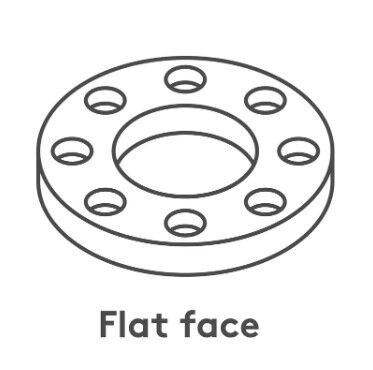
The recessed and raised flange face consists of a recessed surface and a raised surface, with the gasket placed within the recessed area. The advantage of this design is that it effectively prevents the gasket from being extruded, thereby improving sealing performance. Suitable gaskets for recessed and raised flange faces include various non-metallic flat gaskets, covered gaskets, metal-jacketed gaskets, spiral-wound gaskets (with base or inner ring), metal corrugated gaskets, metal flat gaskets, and toothed gaskets. Compared with flat flange faces, recessed and raised flange faces perform better in applications with stricter sealing requirements and relatively higher working pressures. However, this type of sealing face requires special attention to alignment during installation and disassembly to ensure the sealing effect.
The tongue-and-groove flange face consists of a tongue flange and a groove flange, with the gasket placed in the groove. The advantage of this design is that the gasket is located in the annular groove, confined by metal walls on both sides, preventing the gasket from being deformed under pressure and extruded into the pipeline. Since the gasket does not directly contact the internal fluid medium, it is less susceptible to erosion by the medium, making it suitable for high-pressure, flammable, explosive, or toxic media environments with strict sealing requirements. Tongue-and-groove flange faces allow the gasket to self-center during installation, but replacing the gasket can easily damage the sealing surface. In addition, during disassembly, the tongue and groove must be separated axially, so pipeline design must consider the possibility of separating the flange axially. Suitable gaskets for this type of sealing face include various metal and non-metal flat gaskets, metal-jacketed gaskets, and basic spiral-wound gaskets, but the gasket’s diameter and width must match the groove dimensions on the flange face.
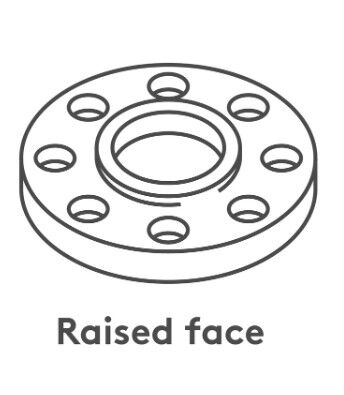
The raised face (marked RF) is the most widely used of the five types. In the JB series mechanical industry standards, it is referred to as “raised face,” but it differs from the raised surface of a recessed and raised flange. This type of raised sealing face is also called a smooth surface, characterized by lacking the pronounced profile of recessed or tongue-and-groove faces. Traditional raised faces have two to three sealing waterlines or patterned waterlines. The outer diameter of the gasket matches the inner circle of the flange bolts, meaning the gasket is positioned inside the circle surrounded by the flange bolt holes, and the bolts help fix the gasket in the center of the flange during installation. The types of gaskets used with raised face flanges are numerous, including various non-metallic gaskets, PTFE-covered gaskets, metal-jacketed gaskets, and spiral-wound gaskets (with outer or inner/outer rings), depending on the pipeline media and pressure. This sealing face is suitable for various working conditions, but due to its structural characteristics, its sealing performance may be inferior to tongue-and-groove or recessed/raised flange faces under high-pressure, flammable, or explosive conditions.
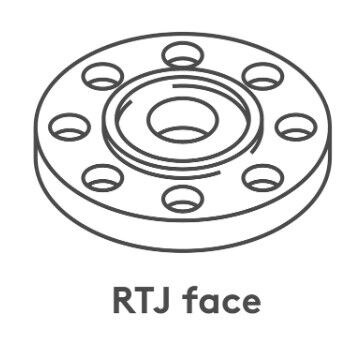
The ring joint flange face (marked RJ) is a special type of sealing face. A trapezoidal annular groove is cut into the raised faces of two stainless steel flanges to hold the gasket and achieve sealing. The compatible gasket is a solid metal ring (metal ring gasket) with an octagonal or oval cross-section, made of steel (e.g., No.10 steel, 1013, alloy steel, stainless steel, etc.). This type of sealing face has excellent sealing performance, requires relatively little precision during installation, and is suitable for high-temperature, high-pressure conditions. However, the machining precision of the sealing face must be high, and installation and disassembly require axial separation of the flange, which must be considered in pipeline design.
After a detailed understanding of flange face types and characteristics, the next step is to explore the types and selection of gaskets. As a key component of the flange sealing system, the performance and selection of gaskets directly affect the sealing effect and reliability of the entire system. Different types of flange faces require matching gaskets, and the material, structure, and characteristics of the gasket determine its suitability under specific operating conditions. Correct gasket selection is crucial to ensuring safe operation of the pipeline system.
Non-metallic flat gaskets are a common type of gasket, with low cost and easy processing. They are typically made from asbestos-rubber sheets or other soft non-metallic materials and are suitable for flat flange faces and some low-pressure pipeline systems. However, non-metallic flat gaskets have relatively poor pressure resistance and corrosion resistance, and caution must be taken when using them in high-pressure, high-temperature, or strongly corrosive media.
Metal-jacketed gaskets are gaskets in which a layer of metal is wrapped around a non-metallic core. This type of gasket combines the strength of metal with the flexibility of non-metallic materials, providing good sealing performance and high pressure resistance. Metal-jacketed gaskets are suitable for multiple flange face types, especially performing well under high-pressure, flammable, and explosive conditions. However, due to their complex structure, their cost is relatively higher.
Spiral-wound gaskets are made by alternately winding metal and non-metal strips. They offer good elasticity and sealing performance, adapting to minor flange surface irregularities for reliable sealing. Spiral-wound gaskets can be selected with or without inner or outer rings, to meet the requirements of different flange faces. They are suitable for multiple flange face types, including raised face, recessed/raised face, and tongue-and-groove flanges, making them a highly flexible sealing solution.
Metal ring gaskets are solid metal gaskets processed into octagonal or oval shapes. They are used with ring joint flange faces to achieve very high sealing performance. Metal ring gaskets have good sealing performance, require relatively little precision during installation, and are suitable for high-temperature, high-pressure conditions. However, they require high machining precision, and axial separation of the flange is necessary during installation and removal, which partially limits their application range.
After discussing the types and characteristics of flange faces and the types and selection of gaskets, we reach a critical stage: the key points for matching flange faces with gaskets. Even if flange faces and gaskets each have their own performance advantages, only when they are perfectly matched can optimal sealing performance be achieved, ensuring the safe and efficient operation of pipeline systems.
When selecting a suitable gasket, the type of flange face must be considered. Different flange face types have different requirements for gasket shape, size, and material. For example, flat flange faces are suitable for non-metallic flat gaskets or covered gaskets; recessed/raised flange faces require various non-metallic flat gaskets, covered gaskets, metal-jacketed gaskets, spiral-wound gaskets (with base or inner ring), metal corrugated gaskets, metal flat gaskets, and toothed gaskets; tongue-and-groove flange faces require various metal and non-metal flat gaskets, metal-jacketed gaskets, and basic spiral-wound gaskets. Only by correctly matching the sealing face type with the gasket can sealing performance be ensured.
The characteristics of the medium in the pipeline are critical for selecting gasket materials. Different media have different corrosion, temperature, and pressure requirements. For high-temperature, high-pressure, or highly corrosive media, gaskets resistant to high temperature, high pressure, and corrosion, such as metal-jacketed or spiral-wound gaskets, are required. For low-pressure, normal-temperature, and weakly corrosive media, non-metallic flat gaskets may suffice. Therefore, gasket selection must consider the medium comprehensively.
The quality of the flange surface directly affects sealing performance. Gaskets must achieve effective sealing with the flange surface, which must be free of defects such as deep scratches, grooves, or abrasions. The flange surface finish can be described using concepts such as roughness, pattern, and waveform.
- Roughness: The average height of protrusions and depressions from the flange surface center, expressed in millionths of an inch (or meters). For serrated flange surfaces, typical roughness is 125–500 μin; for non-serrated surfaces, 125–250 μin. Excessive roughness may prevent gasket sealing, requiring softer gaskets. Overly polished surfaces are also unsuitable, as the sealing surface must provide enough bite to prevent gasket blowout or excessive creep.
- Pattern : The dominant direction of surface texture, such as multi-directional, disc-spiral, or serrated. The surface pattern should align with the gasket centerline. For circular flanges, concentric circles or disc-spiral patterns are preferred. Any straight line crossing the sealing surface can become a direct leakage path.
- Waveform: The deviation relative to overall flatness. Normally, waveform is not critical, but two cases require attention: (1) enamel-coated equipment, where natural glass flow creates large waveform deviations, mitigated by thicker, highly compressible gaskets; (2) warped flanges due to thermal deformation or internal stress, corrected by re-machining, increasing flange stiffness, adding reinforcement ribs, or adjusting bolt arrangement.
The combination of flange faces and gaskets is key to industrial sealing. By deeply understanding different types of flange faces and their applicable gaskets, we can better select suitable sealing solutions. In practical applications, medium characteristics and flange surface quality must be considered to ensure sealing performance. In short, selecting and applying flange faces and gaskets is a complex and important process. Only through scientific selection and strict installation and maintenance can the reliability and safety of the sealing system be ensured. This article aims to provide useful references to help address various sealing challenges in practice.
