FBE-Coated Steel Pipe: Smart Choice for Harsh Environments
In modern industry, pipes play a crucial role as they are responsible for transporting various liquids and gases, ranging from oil, natural gas to water resources. However, pipelines face numerous challenges such as corrosion, mechanical damage, and harsh environmental conditions. These factors can shorten the service life of pipelines, increase maintenance costs, and potentially lead to serious safety incidents. Therefore, selecting appropriate pipeline materials and protective coatings is of utmost importance. FBE-coated steel pipes, as an efficient and reliable solution, have become a preferred material in many industries due to their outstanding corrosion resistance and wide range of applications.
FBE coated steel pipes are a type of pipeline material with an epoxy resin coating applied to the surface of steel pipes. This coating is heat-cured to form a solid protective layer that effectively resists corrosion from water, soil, salts, and other external environmental factors, significantly extending the service life of pipelines. FBE (Fusion Bonded Epoxy) coatings not only have excellent corrosion resistance but also feature uniform coating thickness, strong adhesion, and high-temperature resistance, making them perform well in underground or underwater pipeline projects as well as harsh environments such as high humidity and corrosive soils.
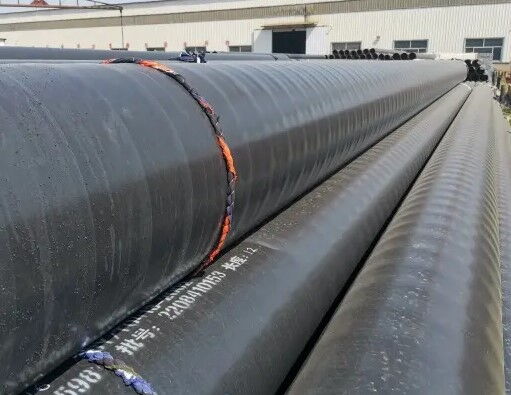
The FBE coating process is a carefully designed procedure intended to ensure that the coating evenly covers the steel pipe surface and forms a robust protective layer. The main steps of the process are as follows:
- Cleaning the Steel Pipe: Before applying the epoxy resin, the steel pipe surface must be thoroughly cleaned to remove rust, oil, and other impurities. This step is usually performed by sandblasting (shot blasting) or chemical cleaning methods. Sandblasting creates a rough texture on the steel surface, which helps enhance the adhesion of the epoxy resin. The cleaned steel pipe surface should be free of any residue to ensure that the coating can adhere uniformly to the pipe.
- Epoxy Powder Spraying: Epoxy resin is typically applied in powder form using electrostatic spraying technology, which uses electrostatic principles to charge the epoxy powder particles so that they firmly adhere to the steel pipe surface. This process is usually conducted in a controlled environment to ensure even distribution of the coating. A uniform coating is a key factor in ensuring the protective performance of the pipeline, as any unevenness in coating thickness may reduce the protection.
- Heating and Curing: After spraying, the pipes are sent into a heating oven and heated to a temperature of 180–220°C. The high temperature melts the epoxy powder, allowing it to flow and form a uniform coating. This process not only tightly bonds the coating to the steel surface but also ensures the uniformity and integrity of the coating. The curing process is the key step in forming the FBE coating, enabling the epoxy resin to fully harden and form a strong, corrosion-resistant protective layer. The cured coating can withstand various environmental factors, providing long-term protection for the pipeline.
- Cooling and Inspection: Cured pipes must undergo cooling treatment and then be strictly inspected. The main inspection items include checking for cracks, bubbles, and other defects in the coating, as well as verifying that the coating thickness meets the required standards. Measuring coating thickness is a crucial step to ensure pipeline performance. Different application environments require different coating thicknesses. For example, pipes used in highly corrosive environments may need thicker coatings to enhance protection. By accurately measuring coating thickness, it is possible to ensure that the pipeline has sufficient corrosion resistance in the intended service environment.
- FBE Coating vs. 3LPE Coating: 3LPE (Three-Layer Polyethylene) coating is a common pipeline protective coating, typically consisting of three layers: the base layer is fusion-bonded epoxy (FBE), the middle layer is a copolymer adhesive, and the outer layer is polyethylene. This three-layer structure provides additional physical protection, giving excellent resistance to mechanical damage and impact. However, compared with FBE coating, 3LPE performs better in low-temperature environments, while FBE exhibits superior tolerance to high temperatures. Moreover, due to the more complex structure and multiple material layers, 3LPE is usually more expensive than FBE. From a long-term perspective, FBE offers higher cost-effectiveness, especially for applications requiring high corrosion resistance.
- FBE Coating vs. 3LPP Coating: 3LPP (Three-Layer Polypropylene) coating provides superior wear and impact resistance compared to FBE. Its outer polypropylene layer offers excellent mechanical protection, making it more suitable for harsh and complex environments. Compared with FBE, 3LPP is more suitable for highly corrosive, high-humidity, and high-salinity environments. FBE, however, performs well in low-temperature, high-moisture environments, making it an ideal choice for most transportation systems, especially underground or underwater pipelines. 3LPP performs excellently under more severe physical conditions, providing higher impact resistance and durability.
- FBE Coating vs. Polyurethane Coating: Polyurethane coatings also offer excellent corrosion resistance in certain environments, particularly in terms of acid and alkali resistance. However, compared with FBE, polyurethane coatings are less effective against saltwater corrosion. Polyurethane is more flexible and is suitable for applications requiring higher flexibility and crack resistance. However, due to its hardness, FBE may crack under impact. The application process of polyurethane coatings is more complex and costly but offers unique advantages in environments with high acid or alkali requirements.
- Excellent Corrosion Resistance: Corrosion resistance is one of the most prominent features of FBE coatings. The epoxy layer forms a dense protective barrier that effectively resists water, chemicals, salt spray, and soil-borne corrosive agents. This strong anti-corrosion ability makes FBE-coated steel pipes highly suitable for underground and underwater pipelines, as well as harsh corrosive environments. Whether in the oil and gas industry or in water supply and wastewater treatment, FBE coatings provide long-term protection, extending the service life of pipelines.
- Strong Adhesion: FBE coatings have extremely strong adhesion to the steel surface and are not prone to peeling or flaking. Through high-temperature curing, the epoxy permanently bonds to the steel surface, ensuring coating integrity during transport and operation. This strong adhesion is a key factor in effectively protecting pipelines from corrosion. Even in harsh environmental conditions, the coating remains firmly attached to the steel pipe, providing continuous protection.
- Good High-Temperature Resistance: FBE coatings are typically cured at temperatures between 180°C and 220°C, allowing the coating to maintain its protective performance in high-temperature environments. For steel pipes operating under high-temperature conditions, this high-temperature resistance is particularly important. It ensures stability and reliability without causing coating degradation or failure.
- Resistance to Mechanical Damage: During transport, installation, and operation, the coating may be exposed to external mechanical impact. FBE coatings have strong resistance to mechanical damage, effectively preventing such impacts from damaging the steel pipe. This helps maintain pipe integrity and reduces the risk of corrosion caused by mechanical impact.
- Environmental Friendliness: FBE coatings are free of lead, heavy metals, or other harmful substances and do not release toxic gases during curing. Therefore, they are considered an environmentally friendly coating technology. Compared with other coating methods, FBE coatings not only protect pipelines but also reduce environmental impact, meeting modern industrial requirements for environmental protection.
- Oil and Gas Industry: FBE-coated steel pipes are widely used in the oil and gas industry, primarily for transporting crude oil, natural gas, and refined petroleum products. Their excellent corrosion resistance makes them ideal for both onshore and offshore pipelines, which are exposed to harsh conditions such as saltwater, soil, and various chemicals. FBE coatings provide reliable protection, ensuring safe pipeline operation.
- Water Supply and Wastewater Treatment: In water supply and wastewater treatment, FBE-coated steel pipes are widely used because they resist corrosion caused by water, soil, and chemical pollutants. They are used in both drinking water distribution and wastewater transport systems. FBE coatings effectively prevent water-borne corrosive substances from attacking the pipeline, ensuring water safety and long-term stable operation.
- Chemical and Petrochemical Industry: The chemical and petrochemical industries transport various corrosive chemicals and fluids that can corrode conventional steel pipes. FBE-coated steel pipes provide a reliable solution for these industries. The coating resists corrosion from multiple chemicals, ensuring pipeline integrity and safeguarding the safety and stability of chemical and petrochemical processes.
- Mining Industry: The mining industry faces harsh working environments, including physical and chemical corrosion. FBE-coated steel pipes are widely used for transporting slurry, minerals, and other corrosive materials. Their strong corrosion resistance helps maintain pipeline integrity, reducing maintenance costs and downtime.
- Offshore Oil and Gas Exploration: Offshore oil and gas exploration requires subsea pipelines, which are exposed to saltwater and other marine elements. FBE-coated steel pipes are an ideal choice for subsea pipelines as they provide excellent corrosion protection. FBE coatings effectively prevent saltwater and other marine elements from corroding the pipe, ensuring safe and reliable operation.
- Environmental Conditions: The environment in which a pipeline operates significantly affects its corrosion resistance. Soil moisture, pH, and chemical composition influence FBE coating performance. In harsher conditions, thicker or higher-quality FBE coatings may be required. For pipelines underwater or exposed to high humidity or saltwater, coatings must resist these factors to ensure durability and reliability.
- Temperature Conditions: Exposure to high or low temperatures can affect FBE performance. High-temperature applications require coatings that can withstand elevated temperatures without degradation. Therefore, when selecting FBE-coated steel pipes, the coating type and thickness should match the actual operating temperature to ensure proper performance.
- Pipe Size and Coating Thickness: Pipe dimensions and wall thickness affect the coating application method and required thickness. Larger or thicker pipes may require specific coating methods or additional FBE layers to ensure uniform coverage and adequate protection. Coating thickness should be selected based on the intended environment and mechanical stresses. For harsher environments or heavy-duty applications, thicker coatings are often required (typically between 300–500 μm).
- Compatibility with Transported Media: If pipelines transport chemicals, gases, or liquids, FBE coatings must be compatible with the medium. Epoxy coatings should resist corrosive fluids. Although FBE coatings resist many chemicals, highly corrosive fluids may require FBE grades designed for specific chemical environments. Internal FBE linings may be necessary for transporting corrosive fluids, while external coatings protect the pipeline from environmental corrosion.
- ISO 21809: ISO 21809 outlines requirements for external coatings of steel pipes used in pipeline transport systems, including FBE coatings. It specifies performance criteria, application processes, and inspection methods to ensure suitability in different environments.
- AWWA C213: AWWA C213 provides guidance on protective coatings for steel pipes and fittings used in drinking water systems, emphasizing coating importance for water safety and pipeline durability.
- DIN 30670: DIN 30670 is a German standard specifying requirements for epoxy and polyethylene coatings on steel pipes for transporting liquids and gases. It covers material selection, application methods, and quality inspection, providing comprehensive guidance for FBE-coated steel pipes.
FBE-coated steel pipes have become an ideal choice in many industries due to their excellent corrosion resistance, strong adhesion, high-temperature tolerance, and resistance to mechanical damage. From oil and gas to water supply and wastewater treatment, as well as chemical, petrochemical, and mining industries, FBE-coated steel pipes provide reliable protection for a wide range of pipeline systems. When selecting FBE-coated steel pipes, environmental conditions, temperature, pipe dimensions, and compatibility with transported media must be considered to ensure the coating meets specific application requirements. By following industry standards and rigorous quality control, FBE-coated steel pipes provide efficient, environmentally friendly, and cost-effective pipeline solutions, ensuring long-term stability and reliable operation of modern industrial pipelines.
