Casing Couplings: Key Connectors in Oil and Gas Drilling
In the process of oil and gas drilling, casing couplings play an indispensable role. They act like a bridge, tightly connecting individual casing pipes, ensuring the stability and sealing of the wellbore. This article will explore in depth the important functions of casing couplings, the various types, connection methods, and their wide applications in the petroleum industry, helping readers gain a comprehensive understanding of the casing coupling.
Casing couplings are important tools used in oil and gas drilling to connect two sections of casing (or drill string), mainly serving the purposes of connection and sealing. Typically, casing couplings are short tubes made of high-strength steel, with internal threads used to join the ends of two casing pipes. This threaded connection has a certain sealing ability, preventing the leakage of fluids or gases in the oil well, thereby protecting the well walls and formations, and maintaining the stability of the wellbore.
Casing pipes and couplings are crucial for maintaining well integrity. They connect sections of piping of various lengths, ensuring a safe and leak-proof seal. This is essential for preventing fluid migration between different geological formations, as fluid migration could lead to contamination and loss of well control. Casing couplings must withstand axial loads, lateral compressive forces, and tensile forces caused by extreme downhole conditions such as high pressure and high temperature, keeping the casing stable and preventing fracture or deformation. The design of couplings helps to distribute stress concentrations downhole, avoiding cracks or fatigue damage caused by excessive local stress, and ensuring the long-term safety of the wellbore.
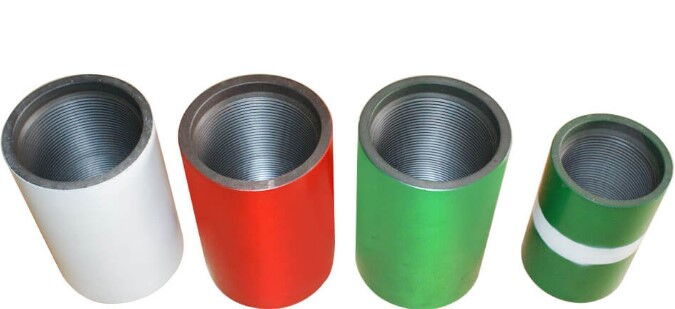
Casing couplings come in a variety of types, mainly to meet different downhole conditions and construction requirements. These types can be classified according to material, connection method, and special functions.
Firstly, according to material, casing couplings can be divided into metal couplings and non-metal couplings.
- Metal Couplings: Metal couplings are usually made of stainless steel, carbon steel, or cast iron, with high strength and corrosion resistance, suitable for high-pressure and high-temperature environments. In oil and gas drilling, metal couplings are the most common type, as they can withstand extreme downhole conditions.
- Non-Metal Couplings: Non-metal couplings are mainly made of rubber, plastic, or composite materials, offering good sealing performance and chemical resistance, suitable for general industrial and civil applications. Although non-metal couplings are less commonly used in the petroleum industry, they are sometimes applied in special circumstances, such as when higher chemical resistance is required.
Secondly, according to connection method, casing couplings can be divided into threaded couplings, flange couplings, and clamp couplings.
- Threaded Couplings: Threaded couplings are the most common type. They connect casing pipes via threads, characterized by simplicity and convenience, suitable for low-pressure and general conditions. Thread designs can be adjusted according to well conditions to improve compressive and tensile performance, while also providing effective sealing.
- Flange Couplings: Flange couplings connect casing pipes via flanges, offering high sealing performance and load-bearing capacity, suitable for high-pressure and high-temperature environments. Flange connections are usually used in cases requiring higher strength and sealing, such as deep wells and ultra-deep wells.
- Clamp Couplings: Clamp couplings connect casing pipes by clamping them, featuring quick and removable operation, suitable for temporary connections and maintenance. Clamp connections are simple to operate, but sealing performance and mechanical strength are limited, typically used in low-pressure shallow wells or test wells.
In addition to the basic classifications above, casing couplings have some special types designed to meet specific downhole conditions and construction requirements.
- Standard Couplings: Standard couplings are used for standard connections, providing basic sealing and structural support. This type is typically the most basic and widely used, suitable for ordinary drilling environments.
- Semi-Extrusion Couplings: When the casing is subjected to large axial loads and lateral compressive forces, semi-extrusion couplings enhance sealing and prevent well wall damage. The coupling design achieves stronger sealing at the end face of the casing, suitable for high-pressure wells and gas wells with harsh conditions.
- Extrusion-Resistant Couplings: Extrusion-resistant couplings are used for special high-pressure wells or sections that need to resist greater compressive forces. By optimizing the structure and thread design, these couplings provide stronger extrusion resistance and sealing under high pressure, preventing fluid leakage.
- Corrosion-Resistant Couplings: Corrosion-resistant couplings are used in corrosive environments to prevent damage to the coupling and casing caused by acidic or other corrosive media. These couplings are made with material coatings or anti-corrosion alloys, suitable for sulfur-containing, salt-containing, or other highly corrosive formations.
- Thickened (Heavy) Couplings: Thickened couplings are used when the wellbore is subjected to higher mechanical loads and pressure, increasing strength and compressive performance. With thicker walls than standard couplings, they are suitable for deep and ultra-deep wells, enhancing casing extrusion resistance and preventing deformation.
- Internally Thickened Couplings: Internally thickened couplings provide higher contact strength, suitable for high-pressure wells, especially deep and ultra-deep well sections. The internal thickening enhances impact and tensile resistance at the connection, typically used in deep well sections.
- Snap-Type Couplings: Snap-type couplings connect the casing via a snap mechanism, mainly for temporary connections. They are easy to operate but have relatively poor sealing performance, suitable for short-term test wells or applications where long-term sealing is not required.
- Sealing Couplings: Sealing couplings provide additional sealing to address potential micro-leakage downhole. Special sealing structures are designed on the inner wall, used for gas wells or water-bearing wells, suitable for sections requiring higher sealing levels.
- Ultra-High-Pressure Couplings: Ultra-high-pressure couplings are used for ultra-high-pressure well sections, providing extremely strong sealing and connection strength. Made with special materials and thickened design, they are specifically for extreme high-pressure and high-temperature downhole environments.
In oil and gas drilling and completion operations, the connection method of casing couplings directly affects the stability and sealing of the wellbore. Different connection methods meet different well conditions, ensuring reliable and safe connections under high-pressure, high-temperature, or corrosive environments.
- Threaded Connection: Threaded connection is the most common casing coupling method, where threads are processed on the ends of the casing and coupling, and the casing is tightened to connect. Thread designs can be adjusted according to well conditions to improve compressive and tensile performance, while providing effective sealing. API standard threads and modified trapezoidal threads are widely used in operations under different pressure and temperature conditions.
- Clamp Connection: Clamp connection uses a clamping structure, connecting two casing ends with fasteners. This method is simple to operate and quick to connect, suitable for short-term or temporary construction. However, clamp connections have limited sealing performance and mechanical strength, usually used in low-pressure shallow wells or test wells, not suitable for long-term downhole use.
- Welded Connection: Welded connection firmly joins the casing and coupling by welding. Because welded joints are prone to corrosion under high-pressure and high-temperature downhole environments, their durability is limited. Therefore, welded connections are mostly used for surface pipelines or situations requiring extremely high strength, and are rarely applied downhole.
- Special Sealing Connection: Based on threaded connections, special sealing connections incorporate sealing rings or elastic sealing elements to enhance downhole sealing. This method is particularly suitable for high-pressure, high-temperature wells, commonly used in deep wells or wells with corrosive fluids, ensuring that downhole fluids do not leak, with excellent sealing performance.
- Tapered Thread Connection: Tapered thread connections achieve tight connections through tapered threads, which generate radial pressure under load to improve sealing. Its unique thread design better resists high downhole pressure, especially suitable for maintaining good sealing and tensile performance in extreme well conditions.
Petroleum casing couplings are drilling tools used to connect casing pipes. They primarily solve the problem of fatigue fractures caused by stress concentration. The structure of petroleum casing couplings connects the casing pipe end to the inner wall of the coupling body via tapered threads, while the top of the coupling body connects to the casing with threads of the same type and pitch. This single-tapered thread connection at the outer thread root reduces stress concentration, prevents fatigue fracture, and achieves better connection, avoiding casing separation accidents.
Petroleum casing couplings are large-diameter components that reinforce oil and gas well walls or boreholes. Casings are inserted into the borehole and reinforced with cement to prevent separation of rock formations and collapse, as well as to prevent mud recirculation, facilitating exploration and extraction. Common steel grades for petroleum casing couplings include H40, J55, K55, N80, L80, C90, T95, P110, Q125, and V150. End processing methods include short round threads, long round threads, modified trapezoidal threads, and snap types.
Casing couplings have significant impact in the petrochemical industry. They are widely used, cost-effective, and have great potential for cost control. Well casing consumption can be calculated per meter drilled. Based on domestic data, approximately 62 kg of well pipes are needed per meter, including 48 kg of casing, 10 kg of tubing, 3 kg of drill rods, and 0.5 kg of drill collars. The mechanical and environmental behavior of petroleum casing couplings plays a critical role in selecting processes and increasing production efficiency. Coupling failure can cause substantial losses, and their performance significantly affects the service life of oil wells in the petrochemical industry.
Couplings are important connecting devices used to join two pipes. Among them, casing couplings and tubing couplings are the most common types. Although both are pipe connectors, there are significant differences.
Casing couplings are mainly used to connect casings and are indispensable in oil well drilling. Their primary function is to maintain casing stability during drilling, preventing well wall collapse or damage to the casing from formation pressure. Casing couplings generally have high strength and rigidity, capable of withstanding large pressures and pressure fluctuations. Additionally, they must have good corrosion and wear resistance to adapt to harsh underground conditions. Structurally, casing couplings usually include steel joints and threaded connection sections. Proper thread design ensures tight connections between the coupling and casing, and material selection and manufacturing processes must meet relevant standards to guarantee reliability and safety.
Tubing couplings are mainly used to connect tubing, an important device in oil production. Their main function is to ensure smooth oil flow and prevent leakage during production. Compared with casing couplings, tubing couplings bear lower pressures but require higher sealing performance. Structurally, they differ from casing couplings, usually adopting finer threads and sealing structures to ensure smooth oil flow and prevent leakage. Tubing couplings also require good corrosion and wear resistance to suit the properties of flowing oil.
- Application: Casing couplings are mainly used in drilling to connect casings, while tubing couplings are used in production to connect tubing.
- Pressure Resistance: Casing couplings must withstand higher pressures and fluctuations, while tubing couplings focus on sealing and experience relatively lower pressures.
- Thread Design and Sealing Structure: Differences exist to meet their respective application needs.
- Material Selection and Manufacturing: Due to different environments and pressure resistance requirements, material choice and manufacturing processes differ.
In practice, casing couplings may encounter issues such as seal failure or fatigue fractures, which can cause severe consequences, including well wall collapse or fluid leakage. Therefore, understanding the causes and solutions is very important.
Seal failure is a common issue, mainly caused by insufficient sealing of threaded connections or aging of sealing elements. Solutions include:
- Optimizing thread design: using high-performance threads, such as modified trapezoidal threads, to improve sealing.
- Using sealing elements: adding sealing rings or elastic sealing components to enhance sealing.
- Regular inspection and maintenance: check the sealing performance periodically and replace aging components in time.
Fatigue fracture occurs due to repeated stress over long-term use. Solutions include:
- Optimizing coupling design: distributing stress concentration to avoid excessive local stress.
- Using high-strength materials: select materials with high strength and fatigue resistance.
- Regular inspection and replacement: periodically inspect couplings and replace those showing fatigue.
Casing couplings play a vital role in oil and gas drilling. They not only ensure stable casing connections but also provide reliable sealing, preventing well wall collapse and fluid leakage. By understanding the various types, connection methods, and applications of casing couplings in the petroleum industry, we can better select and use suitable couplings, ensuring safe and efficient drilling and completion operations. Additionally, understanding the differences between casing and tubing couplings helps us better comprehend the characteristics and applications of these two devices. In practice, attention should be paid to potential issues with casing couplings, and appropriate solutions should be taken to ensure wellbore stability and sealing.
